For decades, small and medium businesses chased a single growth formula: generate more demand. Companies poured resources into marketing, sales, and distribution, assuming growth was purely a front-end game.
For many SMBs, that strategy is becoming less effective. As markets saturate and customer acquisition costs soar, generating demand is no longer your biggest competitive advantage. Today, the real winner isn’t the company that gets the most leads; it’s the business that executes consistently at scale without breaking down.
When operational bottlenecks slow down delivery, miss deadlines, and frustrate clients, even the best marketing campaigns won’t save your bottom line. A quiet transformation is underway across SMB operations. The next era of business growth isn’t about working harder or pushing harder on sales. It’s about building systems that turn daily chaos into predictable execution.
Here’s how operations are evolving and where your business needs to head next.
The Evolution of How Businesses Operate
To see where operations are heading, look at where they started. In the early stages, small businesses rely on informal setups. Teams assign tasks through quick calls, manage work in casual chats, and count on founder involvement to push things over the finish line. This approach feels fast and flexible, but it quickly breaks as the workload grows.
To fix the mess, growing businesses adopt structure. They bring in CRM and ERP platforms to organize data, track finances, and streamline customer pipelines. Reports get sharper, and data finally has a home. Yet, a massive gap remains.
While these traditional tools excel at tracking past performance and storing records, they fail to drive daily action. Businesses can easily see what happened, but they still struggle to ensure tasks get done on time, keep team members accountable, and maintain consistent quality. This disconnect between tracking data and completing work marks the boundary of the current era and sets the stage for the next operational shift.
The Current State: Structured Data, Unstructured Execution
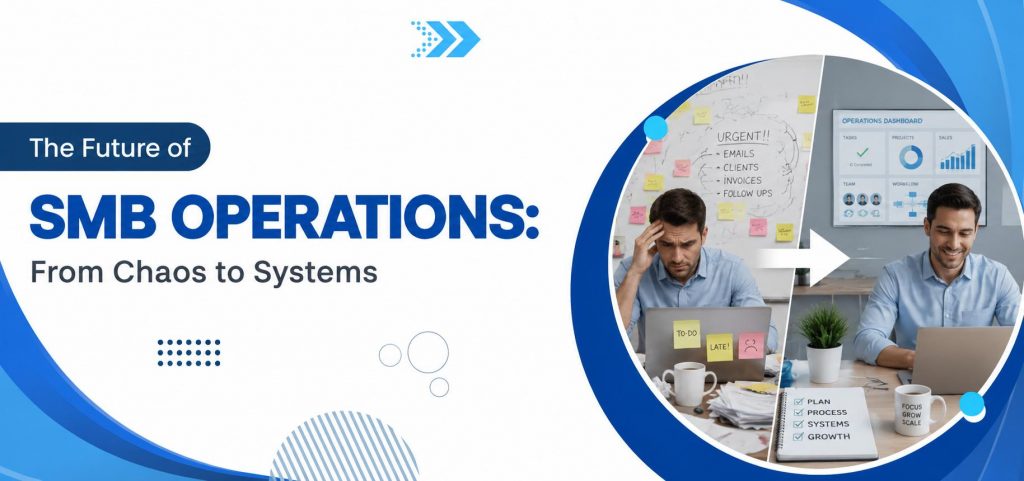
Today, most growing SMBs rely on a broken hybrid operational model. On paper, they look completely organized. They deploy CRMs to manage customer pipelines, ERPs to track financial health, and team chat apps to keep everyone connected. Yet beneath these sophisticated tools, daily execution remains a total free-for-all.
Work rarely originates inside neat, structured project boards. Instead, tasks spawn continuously from quick phone calls, informal chat threads, and hasty meeting notes. Because teams capture work casually, critical details slip through the cracks. No one assigns clear ownership, sets firm deadlines, or tracks progress all the way to completion.
This disconnect creates a dangerous gap between your systems of record and your systems of action.Traditional software excels at logging transactions and archiving history, but it fails to drive real-time effort. Your dashboards show you what happened yesterday, but they cannot guarantee what actually gets done today. You get sharp monthly reports and end-result visibility, but you retain zero control over day-to-day execution. Until you bring structure to how work flows from conversation to completion, clean data will never stop the operational chaos.
The Rise of Execution Systems
To bridge this gap, a new software category is emerging: execution systems. Traditional tools merely store data after the fact. Execution systems are different. They actively guide work from initial intent to final completion. They focus on the exact moment work originates, turning casual chatter into structured action.
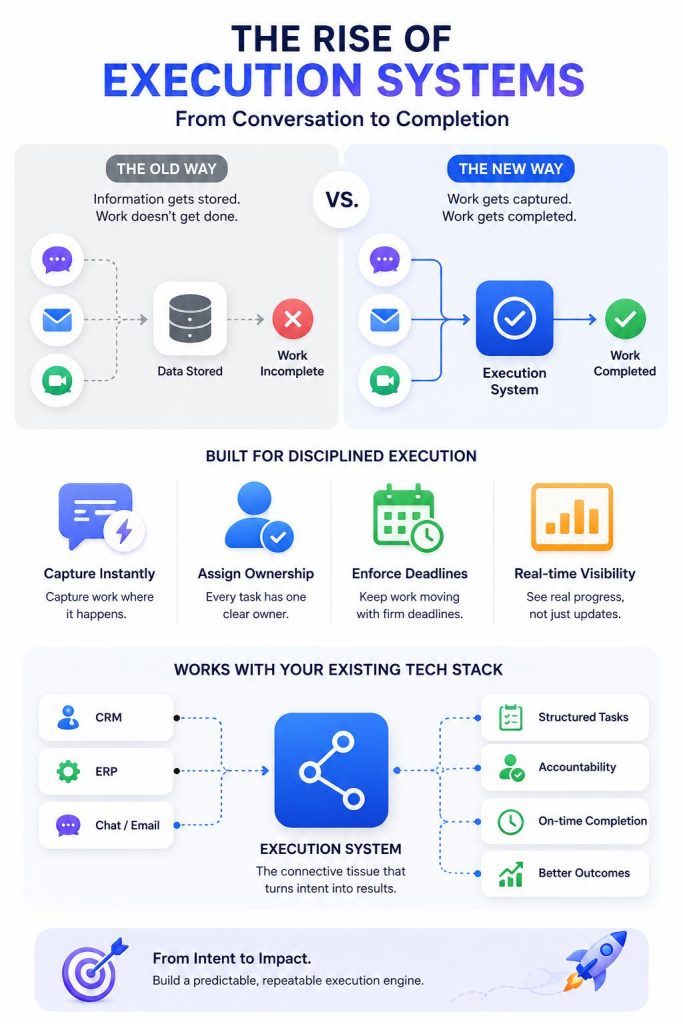
These platforms build discipline directly into daily operations by:
- Capturing work instantly right where it happens—in chats, emails, or meetings.
- Assigning clear ownership so every task has a single accountable owner.
- Enforcing firm deadlines to keep work moving without endless manual chasing.
- Providing real-time visibility so managers see actual progress, not just empty updates.
Crucially, execution systems do not replace your tech stack. You keep your CRM, ERP, and chat apps. Instead, the execution system acts as active connective tissue. It connects those tools together and turns static data into real results.
By eliminating reliance on memory and manual follow-ups, these systems build a predictable, repeatable execution engine.
Why This Shift is Inevitable
This transition isn’t just a trend. It’s an operational reality driven by four unstoppable forces:
- Shrinking Margins: Competition is fierce. Inefficiencies bleed profits. Small delays and missed handoffs quickly destroy healthy margins.
- Distributed Teams: Remote and hybrid setups are standard. Relying on organic, hallway-style communication no longer works when people operate across locations.
- Surging Complexity: Work volume keeps rising. Without a clear system, managers spend more time chasing updates than driving real strategy.
- The AI Breakthrough: Modern software, especially local and embedded AI, can now scan conversations, instantly turn chats into tasks, and track execution with zero manual effort.
Together, these shifts change the game. Staying organized used to be a nice preference. Today, structured execution is a survival requirement.
Businesses that cling to casual chats and manual check-ins will collapse under their own operational overhead. Those that embrace execution systems will scale smoothly with lower costs and sharper output. Many businesses are finding it’s inevitable.
From Chaos to Systems: What Changes
Adopting an execution system completely transforms daily work. It replaces constant firefighting with calm, predictable momentum.
Old habits fade quickly:
- Memory and manual nudges no longer dictate workflow.
- Critical tasks stop vanishing inside buried chat threads.
- Ambiguous ownership becomes a thing of the past.
In their place, system-driven clarity takes over:
- Every task gets captured the moment someone requests it.
- Responsibilities are explicit, leaving zero doubt about who owns what.
- Timelines are enforced automatically, keeping projects moving forward.
- Progress stays visible, giving managers real-time oversight without micromanaging.
Work stops feeling like a scramble. Instead of wondering whether someone dropped the ball, leadership gains total operational confidence. Execution becomes consistent, measurable, and repeatable across every team.
This predictability is the ultimate foundation for growth. When execution runs like clockwork, scaling your business stops creating extra operational headaches, it simply delivers bigger results.
The Competitive Advantage of Execution
Over the next decade, the gap between organized and disorganized businesses will widen into an insurmountable divide. Execution is no longer just a backend function—it is a core strategic moat.
Companies clinging to unstructured execution face severe, compounding penalties:
- Creeping Inefficiencies: Minor handoff delays and miscommunications stack up, quietly eroding profitability on every project.
- Bloated Operational Costs: Teams burn valuable hours chasing updates, sitting in alignment meetings, and fixing avoidable errors.
- Hard Limits on Growth: Unstructured processes simply do not scale. Adding more clients or employees only multiplies the internal chaos.
Conversely, businesses that run on dedicated execution systems unlock a massive advantage:
- Maximum Team Output: Employees spend their time doing real work rather than managing the overhead of work.
- Optimal Resource Allocation: Managers deploy talent effectively because they have real-time data on capacity and progress.
- Repeatable Quality: Output remains consistently high whether you serve 10 clients or 1,000.
This performance gap compounds over time. Brilliant marketing and strong sales reps can bring new prospects through the door, but operational execution determines whether you actually retain them. While competitor campaigns buy temporary market attention, disciplined execution builds scalable, long-term dominance.
Ultimately, mastering execution isn’t just an administrative improvement—it is your most reliable engine for sustainable growth.
Where TaskOPad Fits in This Future
TaskOPad is built for the way modern SMBs work. Teams already use CRMs, ERPs, email, and chat apps to run their business. The challenge is not collecting information. The challenge is turning that information into completed work.
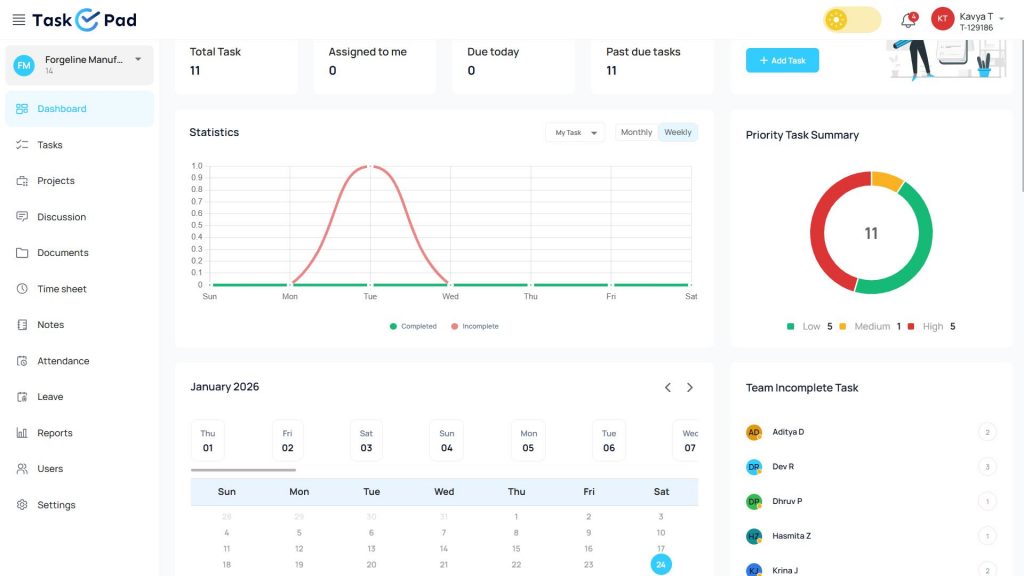
TaskOPad fills this gap. It acts as an execution system that connects communication with action. Instead of letting tasks stay buried in emails, meetings, or chat conversations, it helps teams capture work, assign ownership, set deadlines, and track progress from one place.
It works alongside your existing business tools rather than replacing them. Your CRM continues to manage customer relationships. Your ERP continues to manage business data. TaskOPad ensures that the work created around those systems gets completed on time and with clear accountability.
This approach helps teams stay organized without changing the way they already work. Managers gain better visibility into ongoing work. Employees know exactly what they need to do next. Everyone stays aligned on priorities and deadlines.
As SMBs continue to grow, execution will become just as important as strategy. TaskOPad gives businesses the structure they need to execute consistently, improve accountability, and build operations that can scale with confidence.
The Larger Opportunity
The rise of execution systems marks much more than a new software category. It reflects a fundamental mindset shift in how modern SMBs approach sustainable growth.
For decades, business leaders prioritized front-end expansion. They poured resources into acquiring customers, boosting top-line revenue, and extending market reach. While customer acquisition remains vital, it no longer guarantees long-term survival in a crowded marketplace.
The next wave of growth belongs to companies that optimize their internal operational engines. Industry leaders will build their competitive moats on operational efficiency, execution reliability, and system-driven scalability. Embracing this shift transforms internal workflows from a constant source of friction into a powerful driver of long-term value.
The Real Takeaway
The future of SMB operations won’t belong to the fastest communicators or loudest marketers. It belongs to teams that execute with consistency, clarity, and control. In today’s market, opportunity is abundant; your only limiting factor is execution.
Stop letting critical tasks drown in casual chats and buried emails. Transform your daily operations from chaotic firefighting into a predictable growth engine.
Ready to bridge the gap between communication and execution? Sign up for TaskOPad today or book a live demo to see how structured execution can scale your business.