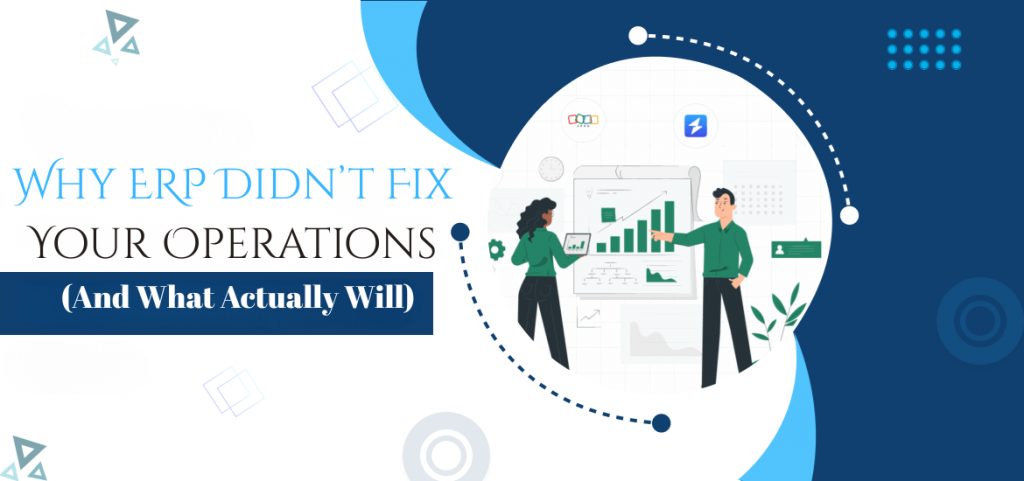
ERP systems promised a revolution. They pledged to bring total control, visibility, and structure to your business. Most organizations adopted them as a decisive move toward operational maturity. In many ways, ERPs delivered. They organized your data, standardized your processes, and created a solid system of record.
Yet, deadlines still slip. Managers still spend hours on manual follow-ups. Operations still rely on individual effort rather than a reliable system. If your ERP brings so much structure, why does your execution still break? The answer is simple: an ERP records what happened, but it doesn’t ensure work actually gets done.
The Misconception: Structure Equals Execution
Many leaders believe that implementing an ERP automatically fixes operational chaos. They assume that because the system organizes data and standardizes processes, the work will simply handle itself. This is a costly misunderstanding. Structure is not the same as execution. An ERP creates a beautiful map of your business, but it doesn’t drive the car.
ERP systems excel at recording transactions and managing resources. They provide a clear “system of record” for what has already happened. However, they lack the agility to ensure daily tasks actually reach the finish line. Knowing you have the inventory or the budget is useless if your team is unable to respect the deadline to move the project forward.
The ERP tells you what happened; it doesn’t ensure that what needs to happen actually occurs. Business failure rarely stems from a lack of data. Instead, businesses fail because they lack a reliable way to enforce accountability and track progress in real time. Data structure is the foundation, but execution is the engine.
The Execution Gap: Where ERPs Fall Short
To find out why operations break, look at how your team actually works. Most daily activity happens entirely outside your ERP. Managers assign tasks in meetings, over phone calls, or through chaotic WhatsApp groups. This informal layer is the actual “task layer” where your business executes daily work.
ERPs completely miss this layer. Because they cannot capture these rapid conversations, critical tasks slip through the cracks. No one formally tracks the assignments, ownership remains vague, and deadlines quickly become optional. You cannot enforce accountability when the work itself is invisible to the system.
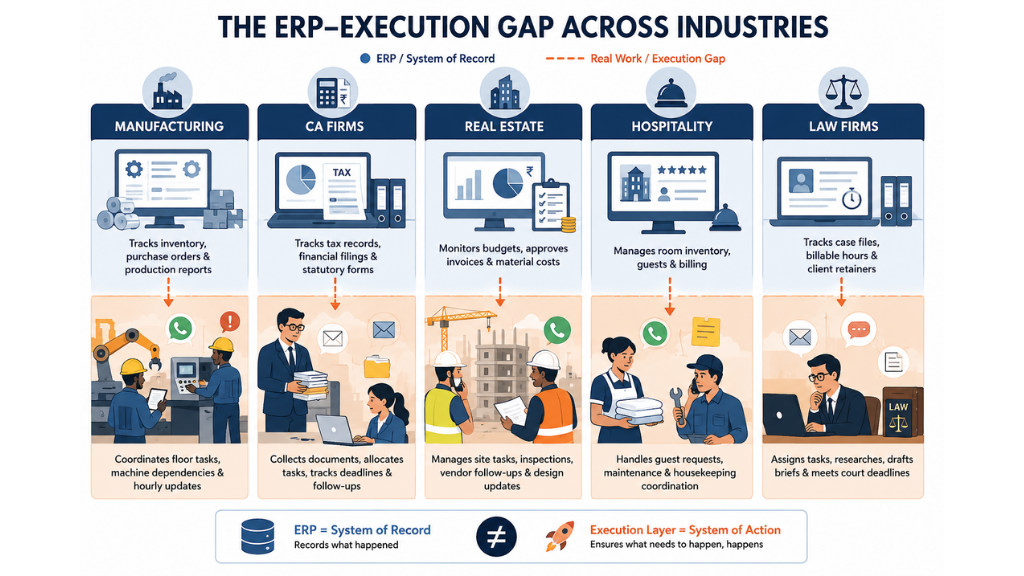
This gap creates a dangerous disconnect in your company. You end up with a robust “system of record” in your ERP, but you lack a true “system of execution.” Your data stays clean, but your actual operations remain disorganized and chaotic.
The Execution Layer: The Missing Link in Your Strategy
Between business planning and final reporting lies a massive, invisible gap: the execution layer. This layer is where your actual work happens. It is where you kick off projects, assign ownership, track daily progress, and deliver final outcomes.
Without a dedicated execution layer, your company plans remain completely theoretical. Your ERP data quickly becomes purely historical information, forcing your operations to stay entirely reactive. ERP systems simply do not have the design to manage this dynamic, fast-moving space.
Expecting an ERP to handle real-time task execution causes major operational bottlenecks. You need a dedicated space that drives active daily work, not just a vault that records past transactions. Shifting focus to this execution layer finally bridges the gap between strategy and actual results.
From Theory to Reality: How the Gap Playing Out Across Industries
Manufacturing
Consider a manufacturing business running a high-end ERP. The system flawlessly tracks raw materials, manages bulk purchase orders, and generates accurate production reports. However, your floor managers still run into constant delays. Why? Because the ERP cannot manage the hourly coordination between procurement and the assembly line. Floor managers end up assigning machine tasks verbally or through messy text groups. When a dependency breaks, the team handles it manually. The ERP accurately captures the delayed outcome, but it completely fails to drive the daily execution that prevents the delay.
Chartered Accountancy (CA) Firms
In a compliance-driven CA firm, specialized software tracks tax records, financial filings, and statutory forms perfectly. Yet, your senior partners still spend hours chasing team members for status updates. The accounting system records the final submission, but it ignores the chaotic process of getting there. Your team must collect documents from clients, allocate specific tax buckets to juniors, and track moving deadlines. Without a dedicated action layer, documents sit in inbox folders, follow-up emails multiply, and your firm faces massive compliance risks.
Real Estate
A real estate developer uses an ERP to control project budgets, approve contractor invoices, and monitor material costs. On paper, the project seems perfectly organized. In reality, the construction site faces constant bottlenecks. The ERP does not manage the daily hustle of site engineers, safety inspections, or vendor follow-ups. Workers pass critical design updates through phone calls rather than a centralized system. Material costs stay within the budget module, but the actual building falls behind schedule because nobody is driving the daily task layer.
Hospitality
A hotel or resort relies on its Property Management System (PMS) to track room inventory, check guest data, and process billing. This system provides a great record of hotel operations, but it fails to run the floor. When a guest requests an extra amenity or reports a maintenance issue, the request often relies on verbal instructions or sticky notes. Housekeeping and maintenance teams work blindly without clear, tracked ownership. The system records the guest’s checkout bill, but it cannot prevent the bad review caused by slow internal coordination.
Law Firms
Law firms use practice management systems to track billable hours, store case files, and manage client retainers. While the software organizes historical client data well, it falls short during active litigation. Preparing for a trial requires drafting briefs, gathering evidence, and meeting strict court filing timelines. Attorneys often assign these micro-tasks through informal conversations. Without a central execution system in law firms, critical research steps get missed. Your system records the billable hours, but it fails to ensure your team completes vital case preparation on time.
Comparison: Where the Work Actually Happens
| Industry | What the ERP/Core System Does (System of Record) | What the Team Actually Has to Do (System of Action) |
| Manufacturing | Tracks raw material stock and logs final production data. | Coordinates floor workers and manages machine dependencies. |
| CA Firms | Stores client financial ledgers and logs final tax filings. | Collects client documents and tracks internal filing steps. |
| Real Estate | Monitors material budgets and tracks vendor invoices. | Manages daily site inspections and engineers’ task lists. |
| Hospitality | Manages room reservations and processes final bills. | dispatches maintenance requests and tracks housekeeping. |
| Law Firms | Archives legal documents and tracks billable hours. | Enforces brief-drafting deadlines and assigns case research. |
Why adding more features to ERP doesn’t solve the problem
When operations break, many organizations try to force a solution by adding more modules, custom workflows, or complex plug-ins to their existing ERP. This approach rarely solves the underlying problem. Instead, it introduces massive software complexity, slows down user adoption, and creates a heavy dependency on constant employee training.
The core issue is not a lack of software features. It is a fundamental mismatch between how developers design ERP systems and how employees actually do daily work. Execution requires extreme simplicity, speed, and immediate action. ERP systems, by their very nature, optimize for rigid data structure and strict corporate control.
You cannot fix an execution problem with a reporting tool. Adding more fields to a complex corporate registry only frustrates your team and drives them back to informal communication channels like WhatsApp. To drive daily action, you need a system built for fast-paced execution, not more ledger entries.
The ideal operating model: ERP + execution system
Stop trying to force your ERP to manage your daily hustle. The most effective businesses separate their operations into two clear categories. They let the ERP serve as the system of record to handle data, transactions, and final reporting. Then, they deploy a dedicated execution system to act as the system of action.
This dual model assigns clear boundaries to your software stack. Your ERP tracks macro outcomes and protects data integrity, while the execution system manages tasks, individual ownership, and real-time deadlines. By decoupling these functions, you get clean compliance data without slowing down your frontline team.
Ultimately, this blueprint builds a highly aligned operational stack. Your strategic planning, daily execution, and final business reporting connect seamlessly. Your ERP ensures you have the resources, but your execution system guarantees your team actually delivers the results.
The Shift Toward Execution-Driven Operations
Modern businesses are moving away from passive monitoring. They now realize that data visibility alone does not fix broken workflows. Process documentation is a great start, but it never guarantees completion. True growth requires a shift toward execution-driven operations where you prioritize action over just observation.
What do successful teams do differently? They implement systems that capture every single piece of work at the source. They ensure every task has a clear owner and every deadline has an automatic enforcement mechanism. This shift moves your entire company from reactive fire-fighting to proactive execution.
Stop relying on manual coordination and start using system-driven workflows. When you track progress continuously and in real time, you eliminate the need for endless follow-up meetings. You no longer just report on what went wrong; you build a culture where work gets done correctly the first time.
Where TaskOPad fits
TaskOPad serves as the essential execution layer that works alongside your existing ERP. We do not aim to replace your ERP; we complement it. While your ERP manages the heavy data and financial records, TaskOPad ensures that the actual daily work moves forward without friction.
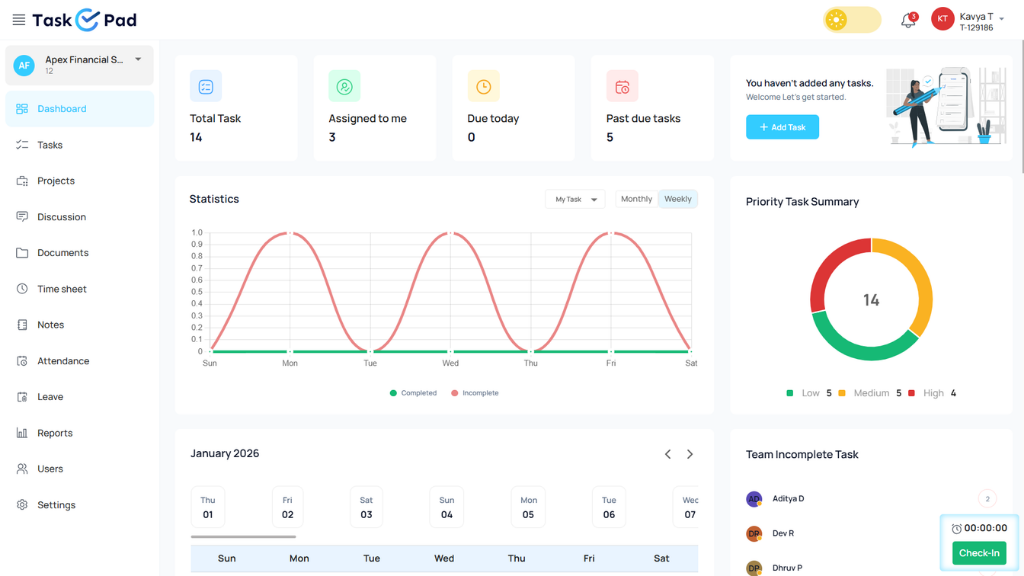
By integrating TaskOPad into your workflow, you can:
- Structure work at the point of creation: Capture every task immediately so nothing slips through the cracks.
- Assign clear ownership: Give every task a specific owner to eliminate confusion and ensure accountability.
- Enforce real-time deadlines: Track progress continuously to hit your targets without manual follow-up.
- Maintain data integrity: Keep your ERP clean while adding a layer of reliability to your daily operations.
- Automate coordination: Replace chaotic WhatsApp groups and endless meetings with streamlined, system-driven workflows.
What Actually Fixes Operations
Operations do not improve because businesses generate more reports or add more dashboards. They improve when teams execute work consistently and on time. Clear execution creates reliable operations. Without it, even the best strategy eventually breaks down.
Strong operations depend on a few simple things. Every task needs a clear owner. Every deadline needs visibility. Teams need a system that tracks progress in real time and highlights bottlenecks before they become major problems. When businesses rely only on manual follow-ups, scattered communication, or individual memory, execution becomes inconsistent and difficult to scale.
The companies that operate efficiently do not just organize data well. They create systems that drive accountability and daily action. They make work visible, structured, and trackable from start to finish. That is what actually fixes operations. Not better reporting. Not more ERP features. But a reliable execution system that ensures work gets completed efficiently, consistently, and at scale.
The Real Takeaway
ERP systems did not fail your business. They delivered exactly what they were designed to do: organize your data and record your history. The real failure lies in expecting a ledger to solve an execution problem. Scaling a business requires more than just managing information. You must ensure that work actually gets done.
Stop blaming your software for operational gaps. Instead, bridge those gaps by adding a dedicated execution layer to your stack. When you separate your system of record from your system of action, you finally unlock true operational maturity. Focus on driving daily results, not just documenting past transactions.
Ready to bridge the gap and fix your operations? Sign up for TaskOPad today or book a free demo to see the execution layer in action!