Most software products start with a list of features. TaskOPad started with a hard truth: the world doesn’t need another project management tool. It needs a better way to execute.
Our founder, Mr. Hiren Thakkar, being an experienced Financial Consultant, has worked with a wide range of industries. After observing CA firms, manufacturers, and agencies, he realized businesses aren’t failing due to a lack of effort but due to a lack of a reliable execution layer. Most tools fail because they ignore the ground reality of how Indian SMBs actually operate. The TaskOPad was developed to bridge the gap between fast-moving conversations and finished results, turning daily chaos into scalable, consistent growth.
The Problem was never “Task Management”
Before building TaskOPad, our foundation team noticed a clear pattern across industries—CA firms, manufacturers, agencies, and service businesses. Work was happening. Conversations were happening. Decisions were being made. But execution kept breaking down.
Tasks were discussed but never recorded. They were assigned but not tracked. They were started but not completed in a structured way. Teams were busy, but outcomes were inconsistent.
The issue wasn’t lack of effort or intent. It was the absence of a reliable execution layer. Most businesses already had tools, but those tools didn’t match how work actually flowed. As a result, important work slipped through the cracks—not because people didn’t care, but because the system didn’t support execution.
The Reality of How Indian SMBs Operate
To understand why most tools fail in the Indian market, we must look at the ground reality. Work doesn’t begin inside a polished dashboard or a structured spreadsheet. It starts in WhatsApp groups, quick phone calls, voice notes, and informal hallway discussions. This is a high-speed, dynamic environment where priorities shift in minutes and documentation is often the last thing on anyone’s mind.
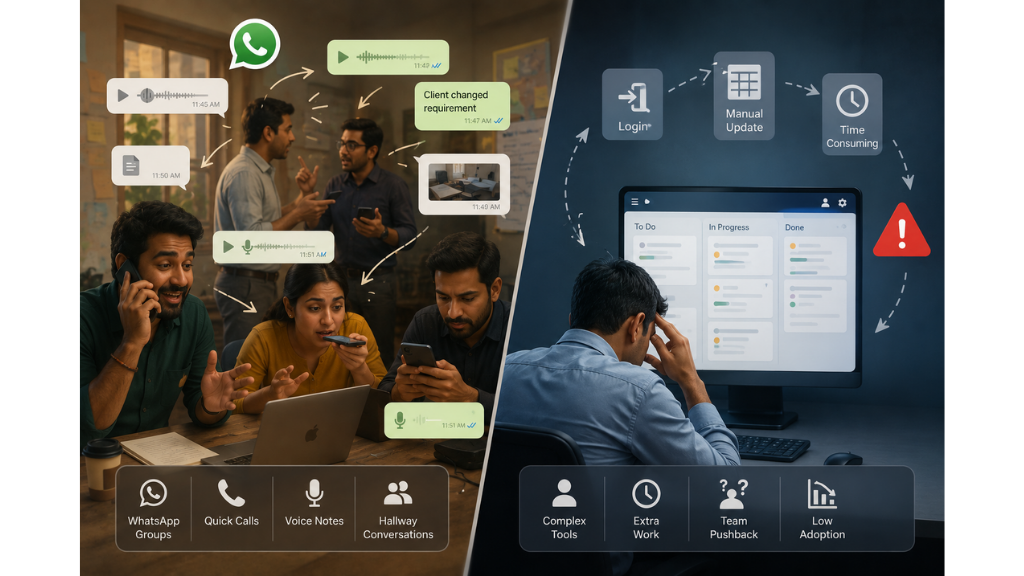
In this reality, instructions evolve in real-time. Expecting a busy team to stop everything, log into a complex global tool, and manually update a status creates immediate friction. When a tool feels like “extra work” rather than a shortcut, teams naturally push back.
Friction is the ultimate enemy of productivity. If a system forces employees to change their natural communication habits just to record a task, they simply won’t use it. Non-adoption isn’t a personnel problem; it’s a design flaw that ignores how Indian SMBs actually function.
Why Global Tools Fail in this Context
Most global project management tools like Asana, Trello, and Jira are built for structured environments. They assume teams follow clear processes, document work consistently, and rely on defined workflows. They also assume the presence of dedicated roles to manage and maintain these systems.
In most Indian SMBs, these assumptions don’t hold. Work moves through conversations, not dashboards. Processes are flexible, and documentation is minimal. When teams are asked to adapt to rigid tools, it adds effort and slows them down.
What follows is predictable; leaders push adoption, teams use it partially, and over time, usage drops. The tools themselves are not broken. They are simply designed for a different way of working, which makes them hard to sustain in this context.
Behavior Must Be the Master, Not the System
One of our biggest realizations at TaskOPad was simple: you cannot force behavioral change at scale. You cannot expect a busy team to suddenly become process-driven or abandon communication-heavy habits overnight. Any system that demands a total shift in how people naturally work is destined to fail. It isn’t because the product is “bad,” but because it is fundamentally misaligned with human reality.
Most tools try to bend the user to fit the software. They require teams to adopt complex workflows and rigid documentation styles that just don’t stick in a fast-moving business. We decided to flip that logic. Instead of forcing teams to change, we believe the system must adapt to existing behavior.
If your team lives on chat and quick calls, a tool shouldn’t punish them for it. It should meet them where they are. By designing for reality rather than an idealized process, you remove the friction that kills adoption and ensure the work actually gets done.
Build for how teams already work
This insight changed our approach completely. We stopped asking, “How do we build a better project management tool?” and started asking, “How do we make sure work gets done where it already happens?” The goal shifted from improving planning to improving execution.
We focused on real workflows, not ideal ones. Work doesn’t start in dashboards, it starts in conversations. So the system needs to capture tasks at that moment, without forcing people to switch tools or follow extra steps.
This shift moved our priorities. We focused less on features and more on outcomes. Less on dashboards and more on workflows. The aim was simple: make execution reliable without changing how teams naturally operate.
The Principles Behind TaskOPad
We didn’t build TaskOPad by looking at other software; we built it by watching how CA firms, factories, and agencies actually operate. These observations led to a set of core principles that define every feature we ship. We moved away from “project management” and toward a dedicated execution layer.
1. Capture Work Instantly
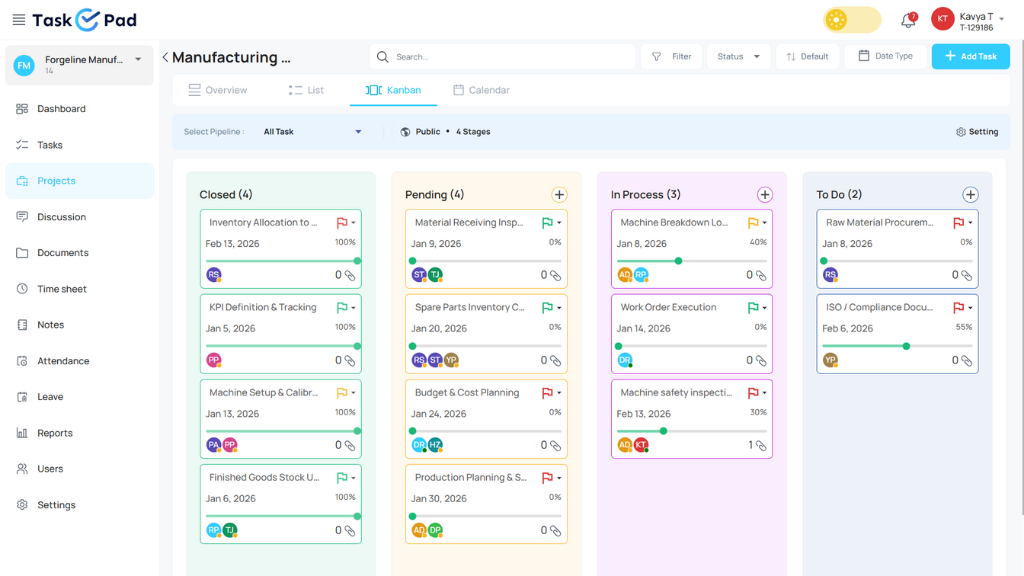
Work shouldn’t depend on manual entry hours after a meeting. If a task starts as a WhatsApp message or a quick phone call, the system must capture it immediately. By closing the gap between the conversation and the record, we ensure nothing falls through the cracks.
2. Eliminate Friction
If a tool requires a three-day training workshop, it will fail in an SMB environment. We design for zero friction. High adoption comes from simplicity, not complexity. If a system feels like “extra work,” teams will naturally revert to old, unstructured habits.
3. Prioritize Execution over Planning
A detailed customized chart is useless if the work isn’t moving. We prioritize the “doing” over the “planning.” Our focus remains on ensuring tasks reach completion consistently and on time, rather than just creating perfect-looking schedules.
4. Visibility without Effort
Founders shouldn’t have to chase team members for updates. We build visibility into the workflow. Managers can see real-time progress and bottlenecks without sending a single “What is the status?” message.
5. Accountability by Design
Reliability shouldn’t depend on a manager’s memory or constant reminders. We bake accountability directly into the system. By assigning clear ownership and automated tracking, we ensure the system enforces the follow-through.
6. Support That Speaks Your Language
Software is only as good as the help you get when things get stuck. Global tools often hide behind automated bots and ticket numbers, leaving you stranded for days. We believe that a system built for the Indian market requires a human touch.
That is why we provide 24/7 human support to ensure your operations never stop. Whether you are a founder setting up a new workflow at midnight or a manager troubleshooting an entry on a Sunday morning, our team is available to help. We don’t just offer “tech support”; we offer an operational partnership. By combining a frictionless product with immediate human assistance, we ensure that your transition from chaos to clarity is permanent.
The Gap Most Tools Never Solved
There has always been a gap between communication tools and project management software. On one side, tools like WhatsApp make communication fast and natural, but work stays unstructured. Important tasks get buried inside chats, calls, and discussions. On the other side, traditional project management systems provide structure, but they often feel rigid and difficult to maintain.
Most businesses end up stuck between these two extremes. Teams continue using communication tools because they are easy and familiar, while structured systems struggle with adoption because they add extra effort.
What was missing was a layer that could connect communication with execution. A system that could bring structure to work without slowing teams down. A system flexible enough to match how businesses already operate, while still creating accountability, visibility, and consistency as the business grows. That is the gap TaskOPad was built to fill.
The Shift has Already Started
The way businesses manage work is already changing. Teams no longer want to spend time manually creating tasks, updating workflows, and chasing follow-ups. They want systems that can reduce coordination effort and turn everyday communication into structured execution automatically.
This shift is becoming visible across the industry. Even platforms like Asana are integrating AI tools like Claude to convert conversations into actionable workflows. The direction is clear: businesses are moving from manual coordination to system-driven execution.
But for this shift to work in markets like India, the solution cannot ignore existing work habits. Teams still operate through calls, messages, and fast-moving discussions. Any system that adds complexity or forces major behavioral change will struggle with adoption.
The future belongs to tools that can bring structure and accountability into existing workflows without slowing teams down.
Building for the Next Phase of SMB Growth
The next decade of SMB growth will depend less on effort and more on execution. Businesses already have access to marketing tools, sales channels, and talent. The real challenge is operational consistency—ensuring work gets completed clearly, on time, and without constant follow-ups.
As businesses grow, communication becomes harder to manage. More people, more conversations, and more moving parts create execution gaps. Without systems that provide visibility and accountability, teams eventually hit operational limits, even when demand keeps increasing.
The businesses that scale successfully will build strong execution systems early. Not overly complex systems, but systems that fit naturally into existing workflows while still creating structure and clarity.
This is where SMB operations are heading—from manual coordination to scalable execution. Businesses that solve this will grow faster, operate more efficiently, and make better decisions as complexity increases.
Where TaskOPad fits
TaskOPad isn’t another project management tool it’s an execution layer designed for the way you already work. We don’t ask your team to stop their conversations and move into a rigid dashboard. Instead, we meet you where the work happens. We turn fluid discussions into concrete actions, ensuring that nothing gets lost between a phone call and the final delivery.
By aligning with existing habits, we remove the friction that usually kills software adoption. We enable teams to convert quick messages into tasks, assign clear ownership, and track progress in real-time. You get the structure required to scale your business without the overhead of complex workflows.
Our goal is to eliminate the need for constant follow-ups. TaskOPad introduces accountability by design, providing managers with total visibility without chasing updates. We bridge the gap between unstructured communication and systematic completion, allowing your business to move fast and stay organized simultaneously.
The Real Goal
The goal was never to build another project management tool. The goal was to solve a much deeper problem: how to ensure work gets completed reliably as businesses grow.
Most teams already communicate constantly. The challenge is turning those conversations into clear execution, accountability, and consistent outcomes without adding friction. That is what TaskOPad is built for.
By aligning with how businesses already operate, TaskOPad helps teams execute faster, stay organized, and scale without operational chaos. If your business struggles with missed follow-ups, unclear ownership, or inconsistent execution, it may be time to rethink how work gets managed.
Sign up for TaskOPad or book a free demo to see how it works.