
Most Chartered Accountant firms do not struggle to find clients. Referrals consistently flow in, tax regulations constantly evolve, and businesses rely heavily on your expertise. On paper, this steady demand creates a clear path to continuous growth.
Yet, a frustrating pattern consistently emerges. Many CA practices scale smoothly until they hit roughly 50 to 100 active clients, and then they suddenly hit a growth ceiling.
This plateau does not happen because you lack market opportunity. It happens because your firm runs out of operational capacity. The limitation isn’t market-driven; it is entirely system-driven. Here is the real reason your execution stalls at scale.
The Nature of Work Inside CA Firms
To understand why many CA firms struggle to scale, look at how a typical CA firm operates. Unlike project-based businesses that handle one big launch at a time, CA firms run on an endless loop of multi-client, deadline-driven execution.
The work is inherently recurring, compliance-heavy, and unforgiving with timelines. Every single client brings a mountain of parallel responsibilities. In CA friends, you aren’t just managing “the client”; you are managing their monthly GST filings, quarterly TDS compliance, annual income tax returns, statutory audits, and endless data reconciliations.
Each of these moving parts has a hard regulatory deadline. Missing one means immediate penalties for the client and a hit to your reputation. Worse, the team cannot even start most of this work until the client sends over their bank statements and vouchers. This creates a hyper-complex environment where tasks pile up, dependencies multiply, and human memory simply cannot keep pace.
Where the Breakdown Begins
Most CA firms do not start with a broken system. In the early stages, managing work through WhatsApp messages, email threads, Excel sheets, and verbal instructions often feels sufficient. Partners stay closely involved, the client base remains manageable, and teams can track work through regular follow-ups.
The problem appears as the firm grows. Every new client adds multiple recurring tasks, deadlines, and document dependencies. Suddenly, teams must manage hundreds of moving parts at the same time. Information gets scattered across different channels. Important tasks get buried in conversations. Follow-ups become difficult to track.
As workload increases, coordination becomes the real challenge. Team members lose visibility into what needs to be done, who owns a task, and which deadlines are approaching.
At this point, the issue is no longer individual productivity. The existing way of working simply cannot handle the growing complexity. The firm starts operating reactively, constantly putting out fires instead of managing work proactively.
The Execution Challenges CA Firms Face at Scale
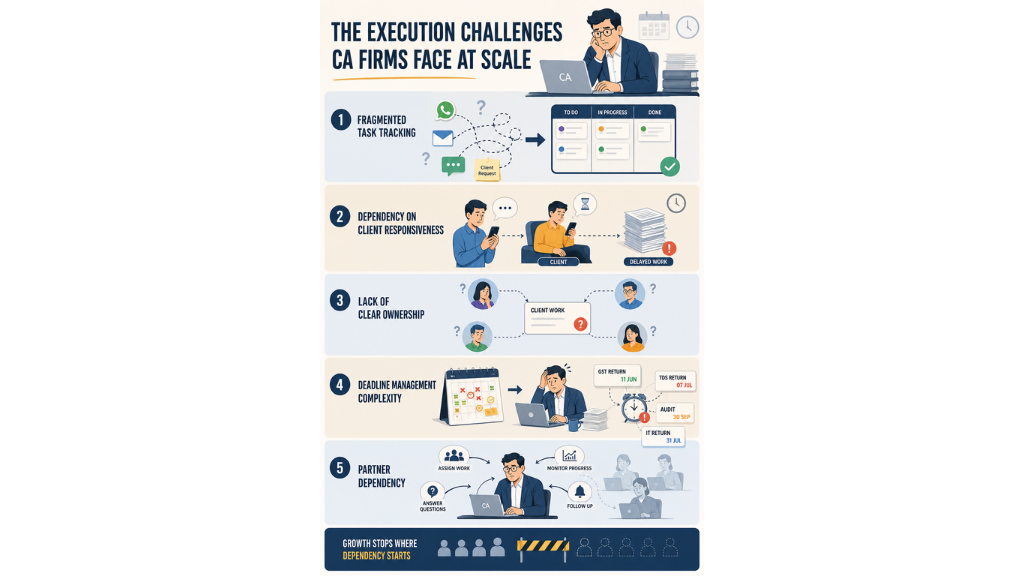
1. Fragmented Task Tracking
Work in a CA firm comes from everywhere. Clients send requests on WhatsApp, team members discuss work internally, and regulatory changes create new responsibilities. The problem is that these tasks often live in different places. Some sit in email threads, others in chat messages, and many stay in someone’s memory. Without a central place to capture work, tasks get missed, duplicated, or delayed. Teams lose visibility, and important work can easily slip through the cracks.
2. Dependency on Client Responsiveness
Most compliance work depends on receiving documents, approvals, and information from clients. A GST return cannot be filed without sales data. An audit cannot move forward without supporting documents. When follow-ups happen manually, communication becomes inconsistent and difficult to track. Some clients receive repeated reminders while others receive none. Small delays from clients quickly create larger delays inside the firm, putting deadlines at risk.
3. Lack of Clear Ownership
As firms grow, work often gets assigned informally. A partner may tell a team member to handle a client’s filing, but responsibility is rarely documented. Over time, confusion starts to build. Team members assume someone else is handling the task. Managers struggle to track progress. When ownership is unclear, accountability suffers. Tasks remain incomplete, deadlines get closer, and issues often surface only when it is too late to react effectively.
4. Deadline Management Complexity
Every client comes with multiple compliance deadlines throughout the year. GST filings, TDS returns, audits, and tax filings all follow different schedules. Managing these deadlines manually becomes increasingly difficult as the client base grows. Teams spend more time checking spreadsheets and calendars than executing work. Without a structured way to monitor deadlines and priorities, firms often operate in reactive mode, rushing to complete work at the last minute.
5. Partner Dependency
In many CA firms, partners become the center of all execution activities. They assign work, monitor progress, answer questions, and follow up on pending tasks. While this works with a smaller client base, it becomes a major bottleneck as the firm grows. Every decision flows through the partner. As a result, growth becomes limited by one person’s capacity to manage and coordinate the entire operation.
The Compounding Effect of these Inefficiencies
Each of these challenges may seem manageable on its own. A missed follow-up, an unclear task assignment, or a deadline tracked in a spreadsheet may not create an immediate problem. But as the client base grows, these small inefficiencies start to compound.
Missed tasks lead to rushed work. Delayed client responses create bottlenecks. Poor ownership creates confusion. Partners spend more time coordinating work and less time serving clients. Teams become increasingly reactive. They spend their days handling urgent issues instead of executing work in a planned manner.
Over time, the impact becomes impossible to ignore. Service quality starts to decline. Deadlines get missed more often. Team stress increases. Clients become frustrated with delays and inconsistent communication. The firm finds it harder to maintain the same level of service across all clients.
At this stage, many firms make a common mistake. They assume they need more people. In reality, adding more staff to a disorganized system often creates even more complexity. The real problem is not capacity. It is the lack of a structured way to manage work at scale.
The Real Constraint: Lack of a Structured Execution System
The root cause of the scaling issue isn’t a lack of talented manpower; it is the total absence of a structured execution system. When you run a firm based entirely on people rather than processes, execution becomes completely unpredictable. You spend your day firefighting problems instead of managing workflows. To break past the 100-client ceiling, the firm must pivot. It must transition business from person-driven execution to system-driven execution.
A reliable system does the heavy lifting for you. It automatically captures every client request from a single entry point, assigns clear individual ownership to every file, tracks statutory deadlines in real time, and provides absolute visibility across your entire operation.
Without this structured foundation, the CA firm will remain stuck in a permanently reactive loop. True operational scale only happens when the system drives the work, allowing the team to execute flawlessly without needing constant partner intervention.
What Scalable CA Firms do Differently
Firms that successfully break past the 100-client ceiling do not rely on harder work or longer hours. Instead, they completely overhaul their operating model, shifting from person-driven execution to system-driven execution.
These scalable firms embed five core pillars into their daily workflows:
- Centralized Task Management: They capture all client requests, emails, and phone calls into a single, unified workspace.
- Absolute Ownership: They assign every single filing to a specific team member, eliminating confusion over who executes what.
- Structured Deadline Tracking: They display all upcoming statutory deadlines on a firm-wide dashboard to prioritize urgent work automatically.
- Automated Client Reminders: They systematically track and trigger document requests, stopping manual follow-up leaks.
- Autonomous Operations: They run daily execution via software workflows, freeing up the partner’s time to focus entirely on high-value client acquisition.
A Case-Style Transformation
Consider a mid-sized CA firm managing 80 active clients. Before restructuring, the firm relied entirely on manual tracking. Team members logged tasks across disconnected Excel sheets, and critical client updates sat buried inside individual WhatsApp numbers. Partners spent over three hours every day simply calling staff for status updates and chasing clients for missing documents. This chaotic workflow led to uneven workloads, last-minute panics, and occasionally missed tax deadlines.
The firm then introduced a centralized, task-based execution system to run its operations. Immediately, the software auto-captured all client requirements as structured tasks. The platform automatically tracked every statutory deadline, clearly assigned filing ownership, and took over client follow-ups via automated alerts.
The transformation was immediate. On-time compliance delivery hit 100%, daily partner intervention dropped by 85%, and overall team productivity soared. Today, the same team seamlessly onboards new clients without introducing operational chaos.
Where TaskOPad Fits
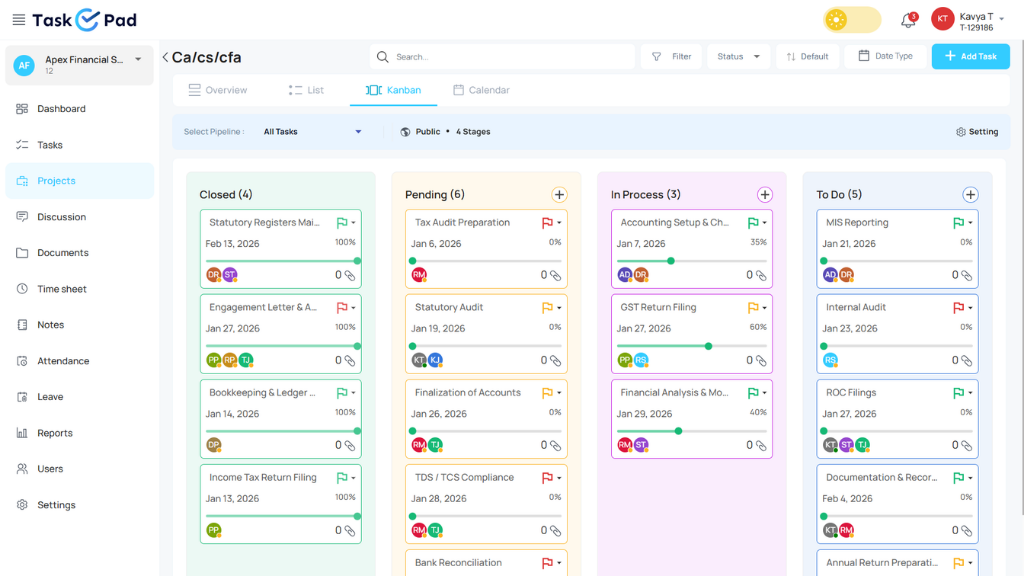
TaskOPad acts as the dedicated execution layer your CA firm needs to break through the 100-client ceiling. It replaces fragmented workflows with a single, structured system designed to handle high-volume compliance.
With TaskOPad, you stop managing work via memory or chaotic WhatsApp groups. The platform immediately converts incoming client requests and internal assignments into clear, trackable tasks. You assign precise ownership to every single file, ensuring your team knows exactly who handles what and when.
The system centrally tracks all statutory deadlines like GST, TDS, and income tax filings – giving your entire firm real-time visibility. It automates recurring workflows and streamlines client document collection, preventing communication gaps from turning into costly penalties.
By introducing a structured workflow, TaskOPad eliminates individual dependency and partner micromanagement. You regain control of your schedule, protect your service quality, and scale your operations smoothly without adding unneeded headcount.
The Real Reason Growth Stops
CA firms do not hit a growth ceiling because the market dries up or client demand drops. In fact, incoming referrals and changing tax laws guarantee a steady stream of new business.
The real reason your growth stops is entirely internal: your daily execution becomes unmanageable, internal coordination breaks down, and your manual setup fails to scale alongside client complexity.
When you pass 100 clients without a structured platform, you aren’t running an accounting practice anymore—you are managing an administrative crisis. Communication gaps expand, tracking sheets fall out of sync, and the entire firm defaults to a chaotic, reactive mode.
Until you replace individual hustle with a centralized workflow engine, market opportunity won’t matter. Your firm will continue to cap its own potential, not because you lack the opportunity to acquire more clients, but because you lack the structural capacity to serve them.
The Path Forward
Growing beyond 100 clients requires more than bringing in new business. It requires building a system that can handle increasing workloads, manage deadlines, track responsibilities, and maintain service quality as the firm expands.
The firms that scale successfully do not rely on memory, spreadsheets, or constant partner involvement. They rely on structured processes that keep work organized and execution consistent.
When you replace reactive workflows with a system-driven approach, your team gains visibility, accountability, and control. Growth becomes easier to manage, and operational complexity stops holding the firm back.
If you’re ready to build a more scalable CA practice, sign up for TaskOPad and book a free demo to see how it can help your firm streamline execution, improve efficiency, and grow with confidence.