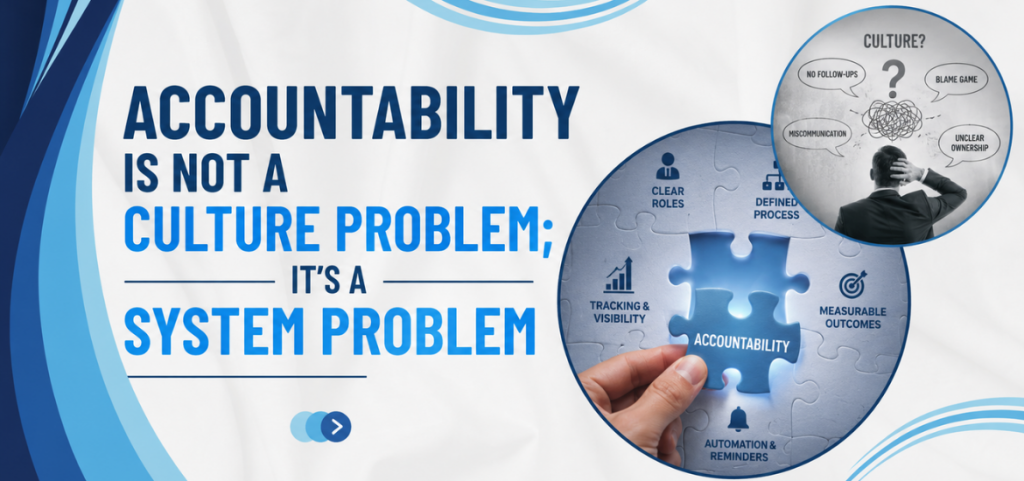
Accountability is one of the most discussed problems in growing businesses. When teams miss deadlines, forget tasks, or fail to deliver expected results, leaders often blame the people involved.
“The team is not proactive enough.”
“Employees need to take more ownership.”
“People need to be more responsible.”
These explanations sound reasonable. But they often miss the real problem. In many cases, employees do not lack responsibility. They lack a clear system for managing work. Tasks remain buried in meetings and messages. Ownership stays unclear. Deadlines are assumed instead of documented. Managers then spend hours following up, while employees struggle with changing expectations.
When this happens repeatedly, businesses start calling it a culture problem. They try motivational talks, stricter reviews, and stronger company values. But accountability cannot depend on reminders and good intentions alone. Before asking people to become more accountable, leaders need to examine how work actually moves through the business. Because what looks like a people problem may actually be a system problem.
Why Accountability Feels Like a Cultural Issue
When teams miss deadlines or forget important work, leaders often see a culture problem. They assume employees lack ownership. Or that people avoid responsibility and do not care enough about results.
But the real problem often starts with how teams manage work. In many businesses, teams discuss tasks in meetings. They assign work through WhatsApp messages or give instructions during quick conversations. Everyone knows that something needs to get done. But no one clearly records the details. Who owns the task? What is the expected outcome? When is the deadline? The team may not have clear answers.
When something goes wrong, there is no reliable record to check. That is when you hear, “I thought someone else was handling it.” Or, “I didn’t know about the deadline.” These statements may sound like excuses. But they often point to missing structure. When expectations remain unclear, accountability becomes subjective. Leaders blame people. Employees blame poor communication. The real problem sits between them: the system the team uses to manage work.
The Limitation of Culture-Driven Accountability
Many leaders try to solve accountability issues by focusing entirely on culture. They rewrite company values, introduce new motivational frameworks, and launch frequent performance reviews. While these initiatives certainly boost team spirit, they completely fail to fix the root issue. Culture can inspire accountability, but it cannot enforce it. Without a functional workflow system, your core cultural values remain abstract ideas written on a wall. Managers must still rely on endless manual follow-ups just to track daily tasks. Project expectations continue to blur, and business outcomes stay completely inconsistent.
Over time, this systemless approach breeds deep frustration across the entire company. Leaders look at missed deadlines and conclude that the team simply lacks ownership. Meanwhile, employees struggle under vague, shifting goals that change without warning. Instead of fixing the broken process, the organization traps itself in a draining cycle of blame. You cannot motivate people into being accountable when they lack the basic tools to execute. Good intentions never replace structure.
What System-Driven Accountability Looks Like
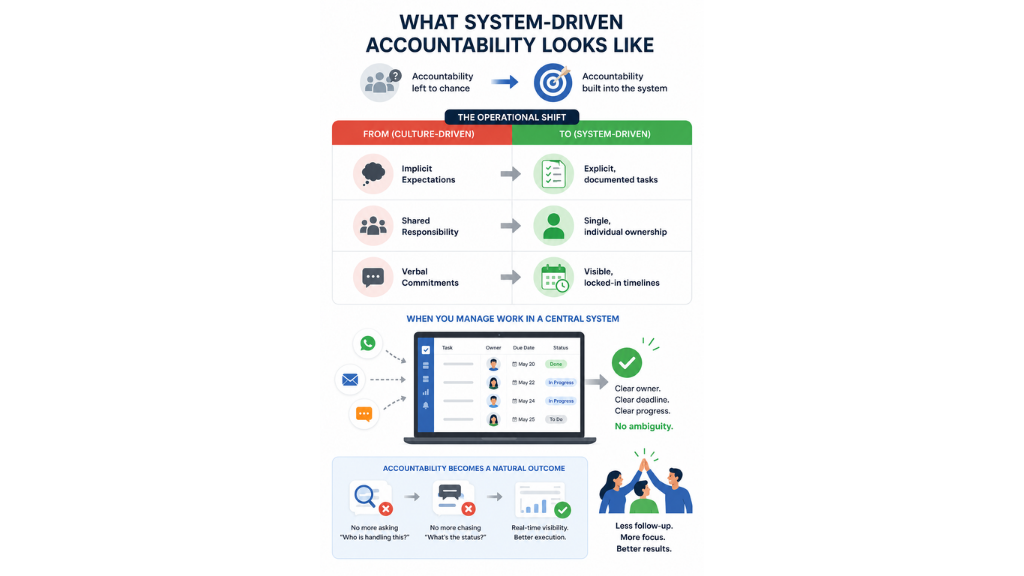
Accountability becomes objective only when you embed it directly into your daily workflow. This requires a fundamental shift in how your business operates. Instead of relying on guesswork, a system-driven environment builds ownership into the tool itself.
The Operational Shift
| From (Culture-Driven) | To (System-Driven) |
| Implicit Expectations | Explicit, documented tasks |
| Shared Responsibility | Single, individual ownership |
| Verbal Commitments | Visible, locked-in timelines |
When you manage work through a central system, you instantly remove ambiguity. Every single task features a clear definition, one assigned owner, a firm deadline, and a real-time progress status.
This infrastructure completely changes your daily conversations. You no longer need to scroll through messages asking, “Who was supposed to handle this?” The system already displays the owner. You stop chasing team members to ask, “What is the status of the project?” The dashboard reflects the current stage immediately.
Accountability stops being something managers must actively enforce through constant reminders, warnings, or awkward meetings. Instead, it becomes a natural, friction-free byproduct of how your team executes work every day.
Why Visibility Creates Ownership
People take more ownership when they can clearly see their responsibilities. The same applies when they can see how their work affects the rest of the team. This is where visibility makes a major difference. When work stays visible in a central system, everyone knows who owns each task. Teams can see deadlines, current progress, and pending work. They can also understand dependencies. If one delayed task blocks another team member, that connection becomes clear.
This visibility naturally encourages people to take ownership. Not because a manager is constantly watching them. But because there is no confusion about expectations or responsibilities. The opposite happens when work remains hidden across messages, spreadsheets, and meeting notes. A delay can go unnoticed for days. Team members may assume someone else is handling a task. Managers often discover problems only when a deadline is already close or missed.
At that point, follow-ups and escalations become unavoidable. Visibility helps teams catch these issues earlier. It gives employees a clear view of their work and gives leaders a reliable view of progress. The goal is not to monitor every move an employee makes. It is to make work clear and measurable. Visibility does not create unnecessary pressure. It creates the clarity people need to take ownership.
The Role of Leadership in System Design
Leaders often expect employees to take more ownership. But they rarely ask whether the current work system makes ownership easy in the first place. Accountability starts with how leaders design and manage work. Leaders decide how teams assign tasks. They define who takes responsibility for each outcome. They also choose how employees report progress and how managers track delays. When these processes lack structure, employees have to fill the gaps themselves. That creates inconsistency.
One manager may track work through spreadsheets. Another may rely on WhatsApp updates. Some teams may discuss progress only during weekly meetings. Employees then spend more time understanding the process than completing the actual work. Leaders need to create a clear and consistent way to manage tasks, ownership, deadlines, and progress. The system should make expectations easy to understand and work easy to track.
A strong system does not remove personal responsibility. It gives employees the structure they need to take responsibility. When leaders design better work systems, accountability becomes easier to maintain. When systems remain weak, even capable and motivated employees can struggle to stay consistent.
A Practical Shift in Thinking
To fix accountability, leaders must fundamentally change the questions they ask. Stop asking, “Why is my team not accountable?” That question targets people and breeds defensiveness. Instead, ask the more effective question: “Do we have a system that makes accountability possible?”
This simple adjustment shifts your entire focus from human flaws to process design. It radically changes the nature of your internal conversations:
- From Blame → Design
- From Reaction → Structure
- From Expectation → Execution
When you judge performance based on a broken workflow, you solve nothing. You just cycle through frustration. True improvement begins the moment you evaluate the system rather than the individual.
The Bottom Line: A flawed system will break a great employee every single time. Stop trying to repair your people. Start designing structured processes that empower them to succeed.
Where TaskOPad Fits
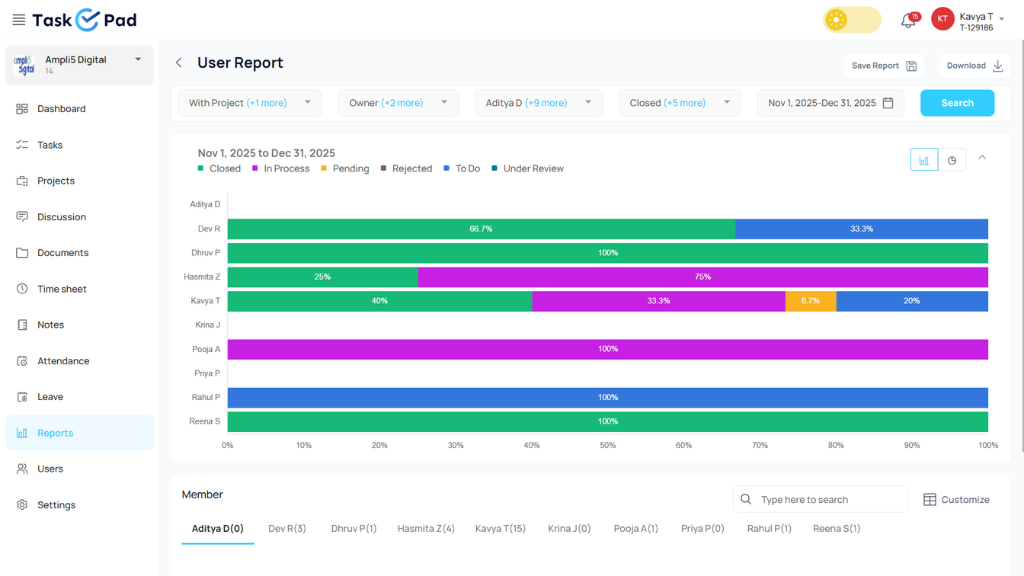
TaskOPad bridges the gap between culture-driven promises and system-driven execution. Our project management tool replaces the chaos of scattered chat apps, endless follow-up meetings, and forgotten emails with a single source of truth.
How TaskOPad Structures Accountability
- Explicit Assignments: Every piece of work becomes a defined task with exactly one owner. You instantly eliminate the confusion of shared or assumed responsibility.
- Locked-in Timelines: Every task requires a specific deadline. The system flags delays immediately, which allows teams to course-correct before a crisis hits.
- Central Visibility: A unified dashboard displays real-time progress. Everyone sees exactly what needs to happen, who owns it, and how tasks depend on one another.
By organizing your workflow inside TaskOPad, you completely eliminate the need for micromanagement. Managers no longer waste valuable hours chasing status updates, and employees no longer struggle under vague, shifting expectations.
Instead, our platform embeds clarity directly into your daily operations. You stop relying on constant reminders or emotional pleas for better ownership. TaskOPad gives your team the exact structural framework they need to make consistent accountability their effortless daily habit.
The Real Takeaway
You cannot build sustainable accountability through good intentions alone. It requires structure. It requires robust systems that explicitly define, track, and manage how work flows through your entire organization.
Without this system-driven foundation, even your most capable and motivated teams will eventually struggle to hit targets. Conversely, with the right infrastructure, your teams will perform consistently and scale predictably.
Ultimately, accountability does not mean pleading with people to do better. It means building an environment where doing better becomes their automatic default setting. Stop fixing your culture. Start fixing your tools.
Ready to transform how your team executes? Sign up for TaskOPad today or book a free demo to build objective, system-driven accountability into your daily business operations.