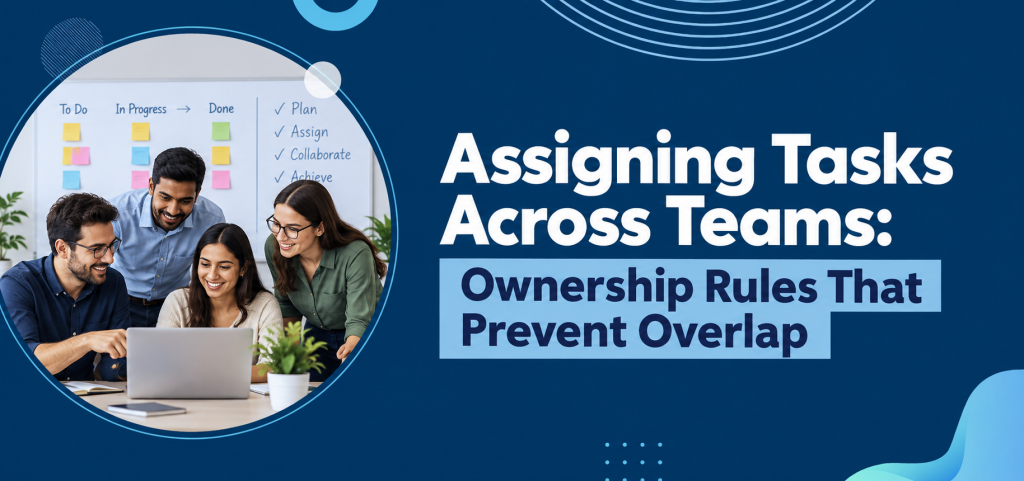
Cross-functional teamwork has become the norm for most businesses. Marketing collaborates with sales, HR works with operations, finance supports every department, and project teams often include people from multiple functions. While this collaboration creates better outcomes, it also introduces a common problem: task overlap.
Have you ever seen two people working on the same task without realising it? Or worse, everyone assumes someone else owns the work, and the deadline quietly slips by. These situations rarely happen because people are unwilling to contribute—they happen because ownership is unclear.
Effective task management is not simply about assigning work. It’s about ensuring every task has one clear owner, supporting contributors understand their role, and everyone can track progress without chasing updates. With the right ownership rules, teams can reduce confusion, avoid duplicated effort, and complete projects more efficiently.
Why Task Overlap Happens
Task overlap usually develops when responsibilities are not clearly defined from the beginning. As projects grow more complex, multiple teams often become involved, making it easier for responsibilities to become blurred.
Common causes include:
- Multiple people believing they own the same task.
- No single person being accountable for completion.
- Tasks being assigned through emails or chat messages instead of a central system.
- Changes in priorities not being communicated clearly.
- Duplicate requests from different managers.
The result is wasted time, unnecessary follow-ups, and frustration across departments.
Why Clear Ownership Matters
When every task has a clearly defined owner, decision-making becomes faster and teams know exactly who is responsible for moving work forward.
Clear ownership helps organisations:
- Reduce duplicated effort.
- Improve accountability.
- Speed up approvals.
- Prevent missed deadlines.
- Increase visibility across teams.
Ownership does not mean one person does all the work. It simply means one person is responsible for ensuring the task reaches completion.
The Difference Between Ownership and Collaboration
One of the biggest misconceptions is that assigning an owner limits collaboration. In reality, ownership and collaboration work together.
| Task Owner | Contributors |
| Accountable for completion | Support execution |
| Tracks progress | Complete assigned activities |
| Communicates updates | Share information |
| Escalates blockers | Provide assistance |
Think of the task owner as the coordinator. Contributors play important roles, but someone must keep everything moving.
Ownership Rule 1: Assign One Primary Owner
Every task should have one clearly identified owner.
For example:
Instead of:
“Marketing team – update campaign.”
Use:
“Priya – update campaign by Thursday.”
This small change removes ambiguity. Everyone knows who is responsible, even if several people contribute. This is where task delegation becomes important, as assigning responsibilities to specific team members makes accountability much clearer.
This becomes especially important when projects involve multiple departments working towards a shared deadline.
Ownership Rule 2: Break Large Projects into Smaller Tasks
Large projects often create overlap because different teams interpret responsibilities differently.
Rather than assigning:
“Launch new product.”
Break it into individual tasks.
| Task | Owner |
| Finalise product copy | Marketing |
| Review legal approval | Legal |
| Update website | Web Team |
| Prepare sales material | Sales |
Smaller tasks create clearer accountability and make progress easier to track.
Ownership Rule 3: Define Dependencies Early
Many tasks cannot begin until another task finishes.
For example:
- Design must finish before development begins.
- Content approval must happen before publishing.
- Client confirmation must arrive before implementation.
When these dependencies are visible, teams avoid starting duplicate work or waiting unnecessarily.
A structured workflow helps everyone understand what comes next.
Ownership Rule 4: Avoid Shared Responsibility Without Clarity
Phrases like:
- “Marketing and Sales will handle this.”
- “Operations and HR can coordinate.”
often create confusion.
Instead, define:
- Who owns the task.
- Who supports it.
- When handovers happen.
Shared responsibility works best when ownership remains clear.
Ownership Rule 5: Centralise Task Visibility
One reason overlap happens is that work lives in multiple places.
Teams often use:
- Emails
- Sticky notes
- Spreadsheets
- Verbal conversations
When tasks are scattered across different platforms, visibility disappears.
Keeping tasks in one shared workspace allows everyone to see:
- who owns each task,
- current status,
- due dates,
- recent updates,
- pending approvals.
This significantly reduces duplicate work. A task tracking system can centralize ownership, status, deadlines, and progress so teams have a shared view of ongoing work.
Ownership Rule 6: Standardise Task Naming
Inconsistent task names create unnecessary confusion.
Instead of:
- Website
- Homepage
- Landing page work
Use:
- Update Homepage Banner – Marketing
Clear naming makes tasks easier to identify, search, and track.
Ownership Rule 7: Establish Status Rules
Every team should use consistent task statuses.
For example:
| Status | Meaning |
| To Do | Work not started |
| In Progress | Owner actively working |
| Waiting | Blocked by dependency |
| Review | Awaiting approval |
| Completed | Finished |
Consistent status definitions reduce unnecessary follow-up messages. Teams can also use workflow management to create a more structured process for moving tasks from one stage to the next.
Instead of asking,
“Is this done?”
The answer is already visible.
Ownership Rule 8: Set Review Checkpoints
Projects rarely fail because of one missed task.
They fail because small issues go unnoticed.
Regular review checkpoints help teams:
- identify blockers early,
- reassign priorities,
- clarify ownership,
- adjust deadlines when necessary.
Even a short weekly review can prevent major delays later.
Real-World Example: Marketing Meets Sales
Imagine a marketing team preparing a webinar.
Without ownership rules:
- Marketing creates slides.
- Sales creates different slides.
- Customer Success prepares another version.
- Everyone edits different files.
The result:
- duplicate work,
- inconsistent messaging,
- last-minute confusion.
With clear ownership:
| Task | Owner |
| Webinar slides | Marketing |
| Speaker briefing | Sales |
| Customer invitations | Customer Success |
| Registration tracking | Operations |
Every department contributes without overlapping responsibilities.
Common Signs Your Team Has an Ownership Problem
Ask yourself these questions.
- Are people frequently asking, “Who’s handling this?”
- Do tasks get completed twice?
- Are deadlines missed because everyone assumed someone else owned them?
- Do managers spend too much time chasing updates?
- Are projects slowed by unclear approvals?
If the answer is yes to several of these, stronger ownership rules can make a significant difference.
How Technology Supports Clear Ownership
As teams grow, manual coordination becomes increasingly difficult.
A structured task management system helps by providing:
- clear task assignment,
- visible ownership,
- real-time status updates,
- due date tracking,
- team-wide transparency.
TaskOPad brings these ownership principles into a central workspace where teams can assign tasks, track progress, manage dependencies and maintain visibility across projects. This helps teams replace scattered updates with a more structured approach to managing responsibilities.
Instead of relying on memory or scattered conversations, everyone works from the same source of truth. This becomes particularly valuable for hybrid and remote teams where face-to-face clarification is less frequent.
Best Practices for Managers
Managers play an important role in reinforcing ownership.
Some practical habits include:
- Assign one owner per task.
- Confirm responsibilities during project kick-offs.
- Document decisions immediately.
- Review workload regularly.
- Encourage team members to raise ownership questions early.
These habits create consistency across projects and reduce unnecessary confusion.
Creating a Culture of Accountability
Strong ownership rules are not about micromanagement. They create confidence.
When employees know exactly what they own, they spend less time seeking clarification and more time delivering meaningful work.
A culture of accountability encourages:
- proactive communication,
- faster decisions,
- smoother collaboration,
- greater trust between teams.
Over time, these improvements strengthen productivity across the entire organization.
Final Thoughts
As organizations become more collaborative, preventing task overlap becomes essential for maintaining productivity. Clear ownership rules help teams work together without duplicating effort or leaving responsibilities unfinished.
By assigning one primary owner, breaking projects into manageable tasks, defining dependencies, and maintaining visibility across teams, businesses can create smoother workflows and stronger accountability.
Whether your teams work in the same office or across multiple locations, structured task ownership makes collaboration more efficient, reduces confusion, and helps projects move forward with greater confidence. TaskOPad supports this approach by bringing task assignment, progress tracking and team visibility into one central workspace.
Frequently Asked Questions
Why is task ownership important in cross-functional teams?
Task ownership ensures every piece of work has one accountable person, reducing confusion, duplicate effort, and missed deadlines.
How can businesses prevent task overlap?
Assign one primary owner, define dependencies, use consistent task statuses, and keep tasks visible in one shared workspace.
What’s the difference between a task owner and a contributor?
A task owner is responsible for ensuring the work is completed, while contributors support the execution of specific activities.
Why do teams duplicate work?
Duplicate work often happens when responsibilities are unclear, communication is scattered across multiple channels, or no single owner has been assigned.
How does a task management system improve ownership?
It provides clear ownership, real-time progress updates, due dates, and shared visibility, making it easier for teams to collaborate without overlapping responsibilities.