Most businesses track visible costs with absolute precision. You know exactly what you spend on marketing, salaries, and lead generation. You measure the direct revenue each client delivers. This financial visibility keeps clear line items under control.
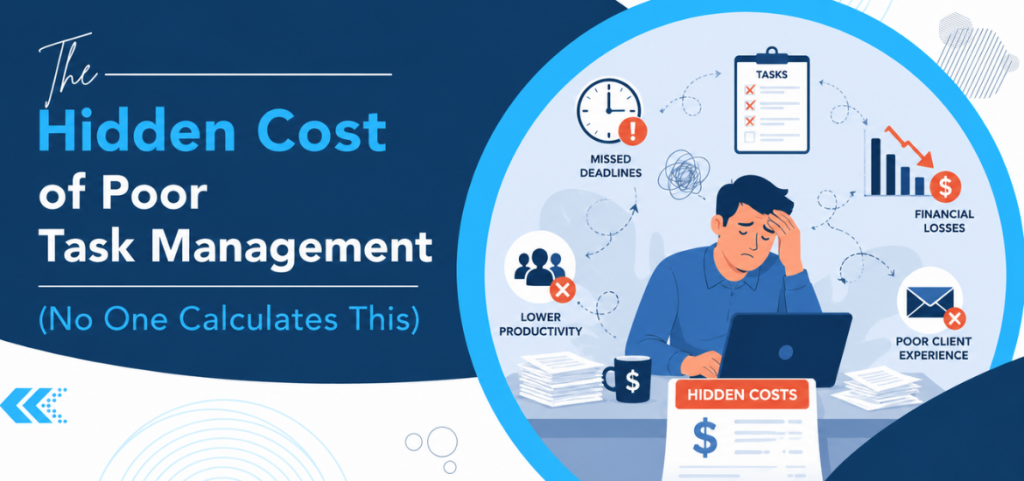
However, you are likely ignoring a critical expense category that never appears on your balance sheet. It receives no budget code and stays out of boardroom discussions. This is the heavy cost of poor task management. It operates silently, bleeding your profit margins every single day while actively capping your company’s ability to scale.
Why This Cost Remains Invisible
Most operational drains show up clearly on a balance sheet. You can instantly spot a spiked marketing budget or a drop in monthly revenue. But the cost of poor task management doesn’t arrive as a single, neat line item.
Instead, it bleeds your business quietly through a hundred minor friction points every day. It hides inside a two-hour project delay, a forgotten client follow-up, or a piece of rework caused by bad communication. On their own, these micro-failures look harmless. Managers dismiss them as “everyday office chaos.”
But when your team operates without structure, these tiny inefficiencies compound. They form a systemic drain that quietly eats away your profit margins, kills team momentum, and caps your ability to scale. You aren’t losing money to a big corporate mistake; you are losing it to a thousand tiny leaks.
Breaking Down the Hidden Costs
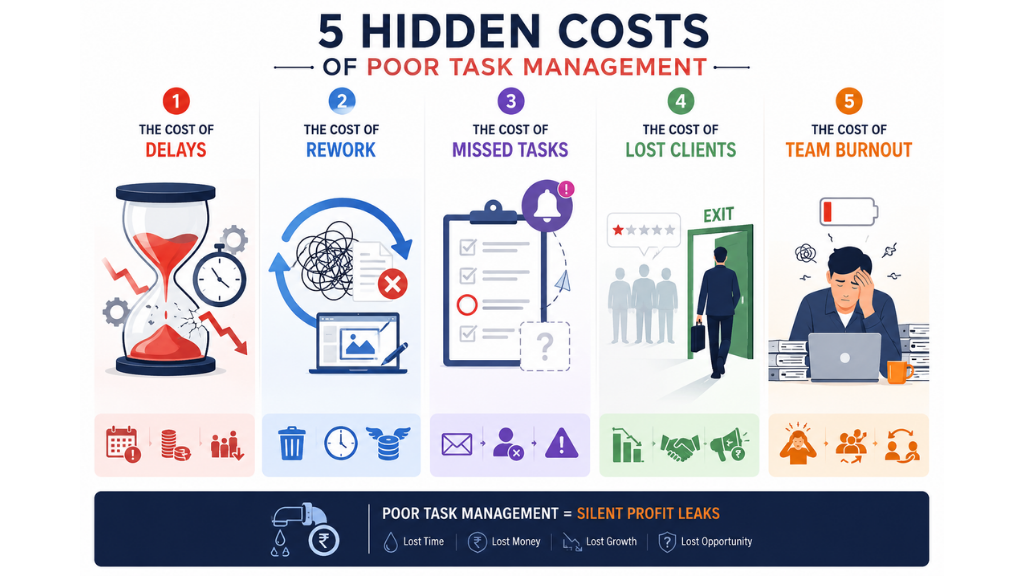
To stop these cash leaks, you must first locate them. The damage doesn’t happen in a vacuum; it occurs during daily operations when execution falls apart. Let’s look at the five distinct areas where poor task tracking directly drains your revenue and caps your company’s growth.
1. The Cost of Delays
When teams don’t track tasks systematically, deadlines slip and timelines become unpredictable. A minor two-hour delay might seem harmless, but it triggers a domino effect. Delayed agency deliverables push back your billing cycles, missed compliance timelines bring heavy financial penalties, and communication gaps halt manufacturing lines. Delays never stay isolated; they cascade across your workflows, fracturing client trust and stalling your business momentum.
2. The Cost of Rework
Rework is a massive, silent drain on your daily productivity. It happens when managers give vague instructions or fail to document core requirements. Without a clear central system, employees move forward on pure assumptions. When the output misses the mark, the team must redo the entire job. If your staff spends just 15% of their week fixing avoidable mistakes, you lose massive operational capacity and throw away paid hours.
3. The Cost of Missed Tasks
Buried in messy chat threads or long email chains, critical actions simply vanish. Unlike obvious delays, you rarely notice a missed task until it creates an absolute crisis. A forgotten client follow-up kills a warm lead, a skipped internal dependency halts a major launch, and an unaddressed compliance check exposes you to legal risks. These oversights quietly destabilize your operations and damage your hard-earned reputation.
4. The Cost of Lost Clients
Poor execution rarely causes immediate client churn. Instead, it slowly destroys client trust over time. When clients face inconsistent deliveries, slow response times, and zero accountability, they quietly look for alternatives. Losing a client costs far more than their monthly retainer. It deletes your predictable future revenue, ruins your brand reputation, and forces you to spend heavily on marketing to acquire a replacement.
5. The Cost of Team Burnout
Unstructured environments place a heavy mental burden on your staff. Employees waste energy remembering daily tasks, digging through chat logs, and chasing updates manually. This constant context-switching fuels workplace stress and tanks daily output. Eventually, this mental fatigue leads to severe burnout. Your top performers check out, employee attrition spikes, and your business faces massive, recurring costs to recruit and train new talent.
A Simple ROI Perspective
Abstract losses can feel distant until you attach actual numbers to them. Let’s look at how much a seemingly minor workflow leakage costs a small team of just 10 employees.
If every team member wastes just one hour per day digging for files, chasing status updates, or sitting through redundant catch-up meetings, the numbers stack up aggressively. Assuming an average, modest resource cost of ₹500 per hour, here is what your business leaks:
| Timeframe | Calculation | Total Revenue Loss |
| Daily | 10 employees × 1 hour × ₹500 | ₹5,000 |
| Monthly | ₹5,000 × 22 working days | ₹1,10,000 |
| Annually | ₹1,10,000 × 12 months | ₹13,20,000 |
The Reality Check: This ₹13.2 Lakh annual loss only accounts for basic time inefficiency. It completely excludes the compounding costs of missed contract deadlines, expensive rework, client churn, and employee recruitment. The true fiscal drain on your business margins is significantly higher.
Why Businesses Fail to Address This
If the math is so alarming, why do most leaders ignore the problem? They fail to act because they cannot fix what they treat as normal. Over time, growing companies normalize internal chaos. They view fragmented communication and missed deadlines as standard “growing pains” rather than fixing the underlying broken workflows.
Furthermore, management traditionally fixes its gaze entirely on revenue generation rather than execution optimization. Leaders assume that throwing more marketing spend or sales effort at the top of the funnel solves growth issues. They choose to bypass efficiency entirely.
When a team falls behind, the default corporate reflex is to hire more people or demand that the current staff simply “push harder.” This approach never works. Adding headcount to an unstructured ecosystem only multiplies the communication channels, introduces new friction points, and deepens the confusion.
Ultimately, businesses accept a chaotic daily environment because they lack clear execution metrics. They manage what they can see like sales closed or marketing spend, while the silent, devastating leakage inside their daily task management continues completely unchecked.
The Shift to Execution Efficiency
High-performing organizations reject the habit of throwing money at systemic chaos. Instead, they shift their strategy entirely toward execution efficiency. These market leaders recognize a simple truth. Optimizing your team’s day-to-day operations impacts your bottom line instantly. It works just as fast as expanding your sales funnel.
Efficient companies stop obsessing over new client acquisition to boost revenue. Instead, they focus heavily on maximizing output from existing resources. They actively work to minimize internal waste. They stop expensive project leaks and build highly predictable execution timelines.
Fixing your operational plumbing expands your business capacity right away. Your existing team handles more work without feeling overwhelmed. They no longer fight administrative friction.
This crucial shift transforms task management entirely. It changes from a back-office chore into a major competitive advantage. Structured systems help you stop chasing chaotic growth. Instead, you pave a predictable, repeatable path to scalable profitability.
What Changes When Task Management is Structured
When you implement a structured task management system, your entire operational dynamic changes. Chaos disappears. Predictability takes its place.
First, delays drop drastically. Teams track every single deadline visually, so tasks no longer slide under the radar. Second, rework decreases. Clear project requirements and central documentation ensure that everyone works from facts, not risky assumptions. Third, you eliminate missed tasks entirely. Central visibility keeps critical client follow-ups and internal dependencies front and center.
This operational consistency directly improves client satisfaction. Your clients receive reliable deliveries and professional accountability. At the same time, your team’s efficiency spikes. Removing the mental burden of remembering tasks lowers cognitive load and reduces workplace stress.
Ultimately, these combined improvements deliver clear business results:
- Higher Productivity: Teams spend their hours executing rather than searching for updates.
- Better Margins: You stop leaking cash into avoidable operational mistakes.
- Improved Scalability: Clean, documented workflows allow you to onboard new clients seamlessly.
By structuring your daily operations, you turn task management from a source of friction into an engine for growth.
Where TaskOPad Fits
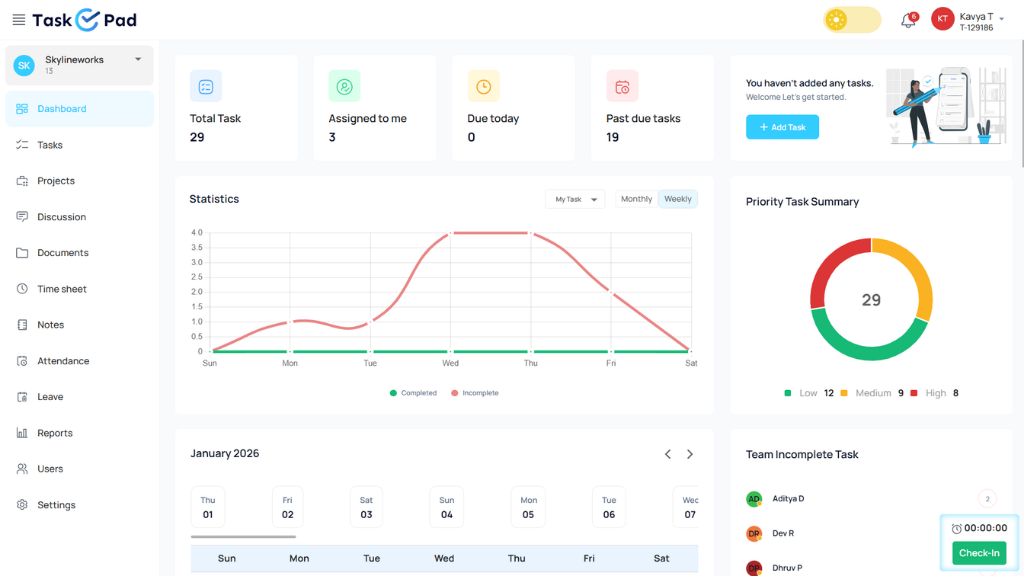
TaskOPad fixes your operational leaks by introducing a structured execution layer to your daily business. It replaces messy chat logs, scattered emails, and mental sticky notes with a single, clear system of record.
Our platform addresses the root causes of daily workflow inefficiency through four core actions:
- Centralize Every Task: You capture all incoming work in one shared space. No task gets buried in an unread email thread or a casual team chat.
- Assign Clear Ownership: Every project receives a designated owner. This clear accountability eliminates the question of who owns the next step.
- Track Deadlines Graphically: Visual timelines and automated alerts keep milestones front and center. Teams finish work on time because they see priorities clearly.
- Maintain Total Cross-Team Visibility:Managers monitor project health instantly without scheduling intrusive micro-management meetings.
By organizing your workflows, TaskOPad minimizes your reliance on employee memory. It eliminates time-wasting manual check-ins and reduces unpredictable execution errors. This direct structural control saves your team valuable hours, cuts avoidable operational expenses, and secures your profit margins. You finally stop fighting daily operational friction and build a predictable, repeatable framework for business growth.
The Real Takeaway
The most dangerous business costs are not the ones clearly listed on your financial statements. The real threat comes from the invisible leaks that you fail to track.
Poor task management functions exactly like a slow puncture. It quietly drains your team’s productive hours, erodes your profit margins, and anchors your business capacity. Until you fix this core execution framework, you will continue to work harder than necessary, earn less than you should, and struggle to scale your operations despite strong market demand.
Do not let unorganized workflows cap your growth potential. Transition your team to a structured system, protect your margins, and claim your true profitability.
Take control of your execution today.Book a free demo with TaskOPad to see exactly how our structured task management tool can plug your operational leaks and scale your business effortlessly.