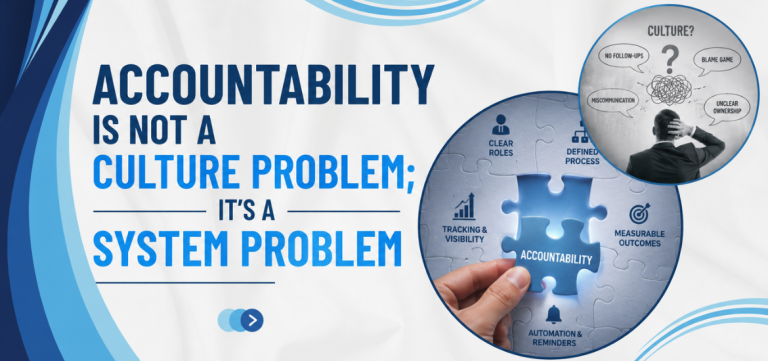
India runs on WhatsApp. For millions of Indian SMBs, this app isn’t just a messenger; it is the engine of daily operations. Founders and teams rely on its speed and simplicity to move fast, bridge hierarchy, and keep the “hustle” alive. It feels efficient because it’s always active, and it works because everyone is already there.
But as your business scales, this same convenience starts to break your team. You eventually realize that a tool built for chatting cannot manage complex execution. You lose tasks in the noise, miss deadlines in the clutter, and confuse “being active” with actually getting work done. If you want to grow without the chaos, you must stop running your business on notifications and start building a real system for execution.
Why WhatsApp became the backbone of SMB operations
In India, WhatsApp isn’t just an app; it’s the default operating system for business. It dominates Small and Medium Businesses (SMBs). And this dominance isn’t accidental, it’s because of the convenience it offers.
The widespread adoption is due to these four key factors:
- Zero Friction: People are already using WhatsApp and are aware of the interface and features. There’s no “learning curve” or expensive training sessions required.
- Universal Access: It bridges the gap between the CEO and the ground-level staff. Whether it’s a delivery partner or a senior manager, everyone is on the same platform.
- Real-Time Speed: It mimics the urgency of a physical office. Queries get answered and files get shared in seconds.
- Workflow Integration: It fits naturally into the cracks of a busy day. Checking a work message feels as seamless as replying to a friend.
For founders in rapid environments, WhatsApp is the path of least resistance. However, this ease of use often masks a growing problem: convenience is not the same as coordination.
The Illusion of Productivity
One of the most dangerous traps for WhatsApp-led teams is the perception of progress. On the surface, the business looks incredibly high-energy: phones buzz constantly, groups stay hyper-active, and messages fly back and forth at lightning speed. This creates a “hustle” atmosphere that mimics high performance.
But you must remember: activity is not execution.
While constant chatter feels productive, it often masks a chaotic reality. You aren’t actually managing work—you are just discussing it. When you run operations inside a chat window, you trigger several structural failures:
- You bury tasks: Action items vanish inside long conversation threads. Instead of clicking a task status, your team wastes time scrolling through hundreds of messages to find an instruction from three days ago.
- You fragment instructions: You scatter critical details across multiple personal chats and groups. This makes it impossible for anyone to see the “big picture” of a project.
- You rely on memory-based management: You force follow-ups and deadlines to depend entirely on a manager’s memory or manual effort. If you forget to scroll back, the task effectively dies.
In this environment, work feels like it’s moving because people stay “active,” but the lack of structure kills accountability. You aren’t managing a scalable business; you’re simply reacting to a never-ending stream of notifications.
Where the System Starts to Break
As your business grows, the volume of communication explodes. What worked for a three-person team becomes a nightmare at scale. At this stage, WhatsApp stops being an asset and starts exposing dangerous limitations.
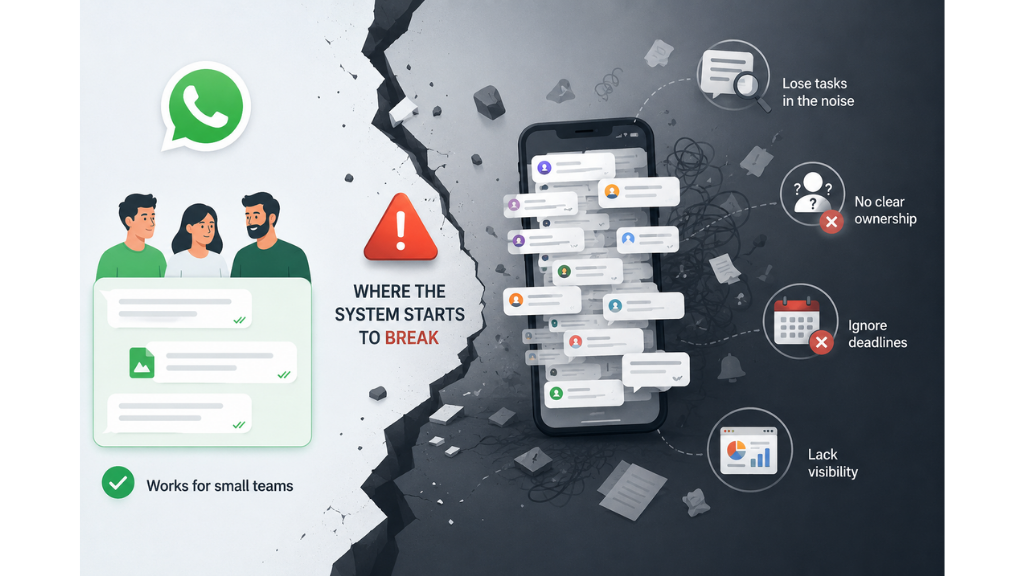
The system breaks because:
- You lose tasks in the noise: Crucial instructions vanish into long message threads. Your team wastes hours scrolling to find a single requirement buried under a mountain of “Okay” and “Noted” replies.
- You lose clear ownership: In a group chat, everyone sees the message, but nobody owns the outcome. People assume someone else is handling it until the deadline passes.
- You ignore deadlines: WhatsApp treats every message with the same urgency. Without a formal calendar or countdown, your team prioritizes the newest message over the most important task.
- You lack visibility: You have no single dashboard to see what’s pending or completed. Instead, you chase updates manually, wasting your day asking, “What’s the status?”
These aren’t just minor glitches; they are bottlenecks that kill your ability to scale.
When WhatsApp Stops Working as a System
As your business grows, communication increases, and WhatsApp starts to break. What worked for a small team becomes difficult to manage. Messages pile up. Teams miss important details because they can’t track everything in chats. People see the same message, but no one takes clear ownership. Responsibility becomes assumed, not assigned. Teams discuss deadlines, but rarely define or track them. Work moves forward without structure, so delays become common. Managers lose visibility as they can’t see what’s pending, in progress, or completed without asking multiple people. So they spend more time chasing updates than driving work.
These problems don’t appear suddenly. They build over time. At first, everything feels manageable. Then tasks slip. Errors increase. Deadlines get missed. The team still works hard, but the system fails them. The issue isn’t effort or communication speed. The issue is the lack of structure. And more messages only make it worse.
Communication Tools are Not Execution Systems
You must distinguish between two fundamentally different functions: exchanging information and completing work. WhatsApp excels at the former but fails at the latter. It facilitates rapid conversation, yet it lacks the native architecture to ensure a task actually reaches the finish line.
When you rely on a chat app to manage your operations, you force your business to run on memory, manual coordination, and endless follow-ups. While communication tools move data, execution systems move projects. A message asks a question; an execution system tracks the answer, assigns a deadline, and records the outcome.
This dependency on chat becomes unsustainable as your business gains complexity. You cannot scale a company that lives in a chat bubble because you are substituting a notification for a workflow. To grow, you must stop treating “sent messages” as “finished work.”
Don’t replace WhatsApp, Add structure on top
Many founders try to fix the problem by replacing WhatsApp with a new tool. This usually fails. Teams resist change, workflows break, and productivity drops in the short term. Instead of replacing WhatsApp, teams should build a layer on top of it. Keep communication where it already happens, but add a system that captures and manages work. Convert messages into tasks. Assign clear ownership. Set deadlines. Track progress outside the chat.
This approach keeps the speed and comfort of WhatsApp while adding the structure teams need to execute. The goal isn’t to change how teams communicate. The goal is to change how they manage work. When teams layer execution on top of communication, they reduce confusion, improve accountability, and scale without chaos.
Turning Chats into Committed Action
Scalability requires a fundamental shift in how you handle information. You must move from a communication-driven mindset to an execution-driven one. Currently, your workflow likely follows a risky cycle: Message → Assumption → Follow-up. This path relies on luck and memory, often leading to missed details and delayed deliveries.
To fix this, you must transform vague messages into structured tasks. The new formula is simple: Message → Task → Ownership → Deadline → Completion. This shift ensures that every request becomes a trackable unit of work with a clear owner and a firm due date.
By making this change, you eliminate the “I thought he was doing it” excuse. You stop chasing people for updates because the system provides progress at a glance. Most importantly, you reduce the mental load on yourself, moving from a constant state of coordination to a position of true leadership.
TaskOPad Bridges the Gap Between Chat and Completion
TaskOPad acts as the structured execution layer your business currently lacks. We designed it to sit alongside your fast-paced communication, serving as the “Source of Truth” for your team. Instead of fighting against the tools your team already uses, TaskOPad provides the destination where those casual conversations turn into trackable outcomes.
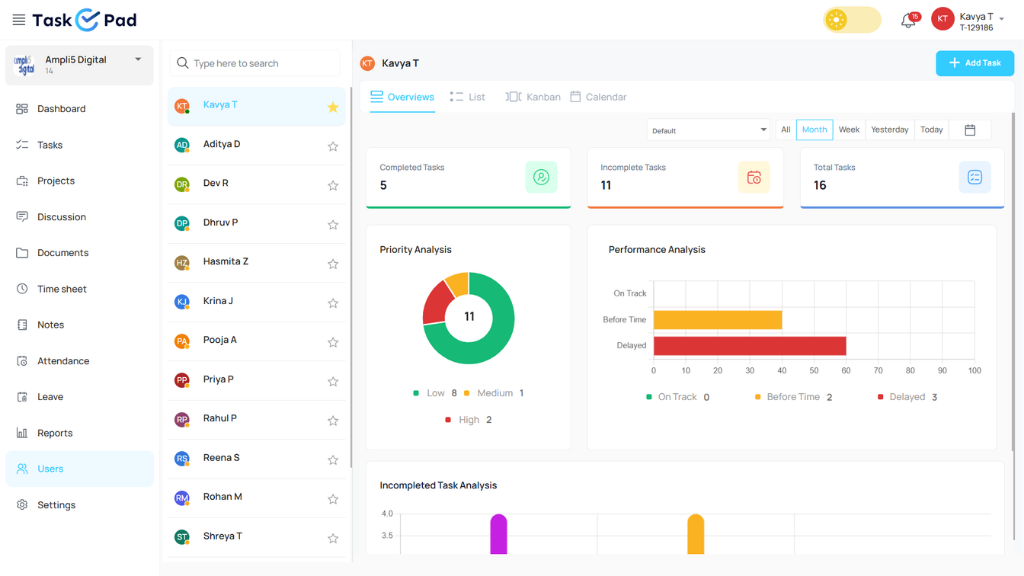
You simply take the requirements discussed in chat and log them into TaskOPad as formal tasks. By doing this, you assign clear ownership to every request, define strict deadlines, and set priorities that everyone can see. This removes the guesswork from your operations. Your team continues to communicate at high speed, but TaskOPad ensures that every discussion results in actual progress.
By using TaskOPad, you eliminate the need for manual follow-ups and constant “status check” calls. You monitor progress through a single, centralized dashboard that provides total visibility. We don’t ask you to abandon WhatsApp; we simply give you the structure required to manage the work that comes out of it.
The hidden cost of running work on WhatsApp
Relying only on WhatsApp for execution creates problems that don’t show up immediately. At first, everything feels manageable. But over time, small gaps turn into real business costs. Teams miss deadlines because tasks aren’t tracked clearly. Clients follow up more often, and trust starts to drop. Work gets redone because instructions were unclear or lost in chats. This increases effort but doesn’t improve output.
Managers spend more time chasing updates than driving results. Teams stay busy but feel constantly behind. This leads to frustration and burnout. As these issues build up, margins shrink and growth slows down. The problem isn’t visible in one moment, it compounds over time. If businesses don’t fix this early, they don’t just lose efficiency. They lose the ability to scale without chaos.
Execution drives growth—not just communication
As businesses grow, fast communication becomes normal. It no longer gives you an advantage. What matters is how well your team executes work. High-performing teams don’t just talk more—they track work, assign ownership, and meet deadlines consistently. They rely on systems, not memory or constant follow-ups.
If you want to scale without chaos, you need to move beyond chats and build structured execution into your workflow. TaskOPad helps you do exactly that; bring clarity, accountability, and visibility to your work. Sign up for TaskOPad and book a free demo to see how your team can execute better and scale faster.