Every project has tasks that matter more than others. Miss one of them, and your entire timeline slips. The challenge for most project managers is knowing, in advance, exactly which tasks those are before a delay makes it obvious.
That is the problem the Critical Path Method was designed to solve.
In this guide, you will learn exactly what CPM is, how to calculate the critical path with a real working example, how it compares to other methods, and how TaskOPad helps you apply it without building complex network diagrams by hand.
What is CPM in Project Management?
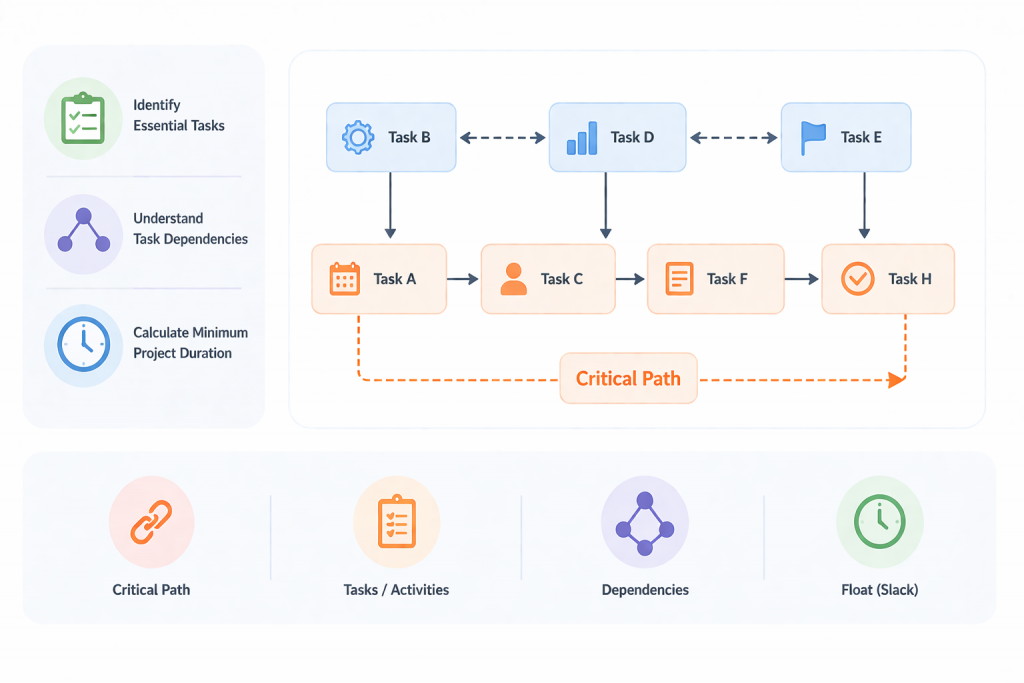
CPM — which stands for Critical Path Method is a project scheduling technique that identifies the longest sequence of dependent tasks in a project and uses it to determine the shortest possible time in which the project can be completed.
In practical terms, it answers three questions that every project manager needs answered before work begins:
- Which tasks, if delayed, will push back the project deadline?
- Which tasks have flexibility — and how much?
- What is the absolute minimum time this project can take?
The critical path is the sequence of tasks that answers the first question. Any task on that path has zero scheduling flexibility. Any delay to a task on the critical path is a delay to the entire project. Tasks not on the critical path have what is called float, some room to slip without affecting the final deadline.
CPM Full Form: CPM stands for Critical Path Method. It is also referred to as Critical Path Analysis (CPA) in some industries.
Understanding the Critical Path
The critical path in project management is the longest chain of dependent tasks that determines the shortest possible project duration.
Any delay in this path will delay the entire project.
Key Terms Explained
| Term | Meaning |
| Critical Path | Longest sequence of tasks |
| Tasks/Activities | Individual units of work |
| Dependencies | Task relationships |
| Float (Slack) | Extra time available for non-critical tasks |
How the CPM Works
The critical path method follows a clear and practical approach to planning projects, often supported by modern workflow software to simplify execution:
- List all the tasks and break the project into smaller, manageable steps.
- Identify dependencies to understand which tasks rely on others.
- Estimate how long each task will take to complete.
- Create a network diagram to map out the sequence of tasks.
- Identify the critical path, which is the longest chain of tasks that determines the project timeline.
- Calculate float time to see which tasks can be delayed without affecting the final deadline.
This structured process helps you stay organized and keeps your project on track.
Examples of CPM in Various Industries
Let’s understand how the CPM is used across different industries with simple examples:
| Industry | Tasks | Key Dependency Insight |
| Software Development | Planning → Development → Testing → Deployment | Each step depends on the previous one; testing starts only after development is complete. |
| Construction Projects | Foundation → Structure → Electrical Work → Finishing | Electrical work cannot begin until the structure is completed. |
| Event Planning | Venue Booking → Invitations → Speaker Arrangement → Event Execution | Invitations depend on venue confirmation, and the event requires finalized speakers. |
| Marketing Campaigns | Strategy Planning → Content Creation → Campaign Launch → Tracking | Content must be ready before launching the campaign. |
In every industry, CPM helps identify task sequences, manage dependencies, and focus on the critical path that directly impacts the project deadline.
Advantages of CPM in Project Management
Several advantages of CPM make it a powerful and reliable project management tool for teams of all sizes.
Key Benefits:
- Clear project timelines – CPM helps define exact start and end dates, making the entire schedule easy to understand and follow.
- Better prioritization of tasks – It highlights critical tasks, so teams can focus on what truly matters for timely completion.
- Improved resource allocation – Resources can be assigned more efficiently based on task importance and sequence.
- Early identification of delays – Potential delays are spotted in advance, allowing quick corrective action.
- Better decision-making – Managers can make informed choices using clear project insights.
- Increased productivity – With structured planning, teams work faster and more efficiently.
Using CPM project management ensures better control, improved coordination, and confident execution of projects.
Challenges of Using the CPM and How to Handle Them
While the CPM critical path method is effective, it comes with some challenges.
Common Challenges:
- Requires accurate time estimates
- Can become complex for large projects
- Needs continuous updates
- Limited flexibility for uncertainty
Solutions:
- Break projects into smaller tasks
- Use reliable data for estimates
- Review progress regularly
- Combine CPM with other methods
A balanced approach helps you get the best results.
CPM vs Other Project Management Methods
While the CPM is highly effective for planning projects with clear timelines and task dependencies, it is not the only project management approach available. Different methods suit different types of projects.
| Method | Best For | Key Focus | How It Differs from CPM |
| CPM (Critical Path Method) | Projects with fixed deadlines and dependent tasks | Identifying the longest sequence of tasks | Focuses on timelines, dependencies, and critical tasks |
| PERT | Projects with uncertain timelines | Estimating task duration using probabilities | Better for projects where time estimates are unclear |
| Gantt Charts | Visual project scheduling | Timeline view of tasks and milestones | Easier to read visually but less focused on critical dependencies |
| Agile | Fast-changing projects like software development | Flexibility and iterative progress | Works in short cycles instead of fixed task sequences |
| Kanban | Continuous workflows | Visual task movement and workload balance | Best for ongoing work rather than deadline-driven projects |
Which Method Should You Choose?
- Choose CPM when deadlines are strict and task order matters.
- Choose PERT when task durations are uncertain.
- Choose Gantt Charts for a simple visual schedule.
- Choose Agile for projects that need flexibility and regular changes.
- Choose Kanban for continuous task management and team workflows.
In many cases, businesses combine CPM with modern tools and other methods to improve planning, tracking, and execution.
TaskOPad for CPM Implementation
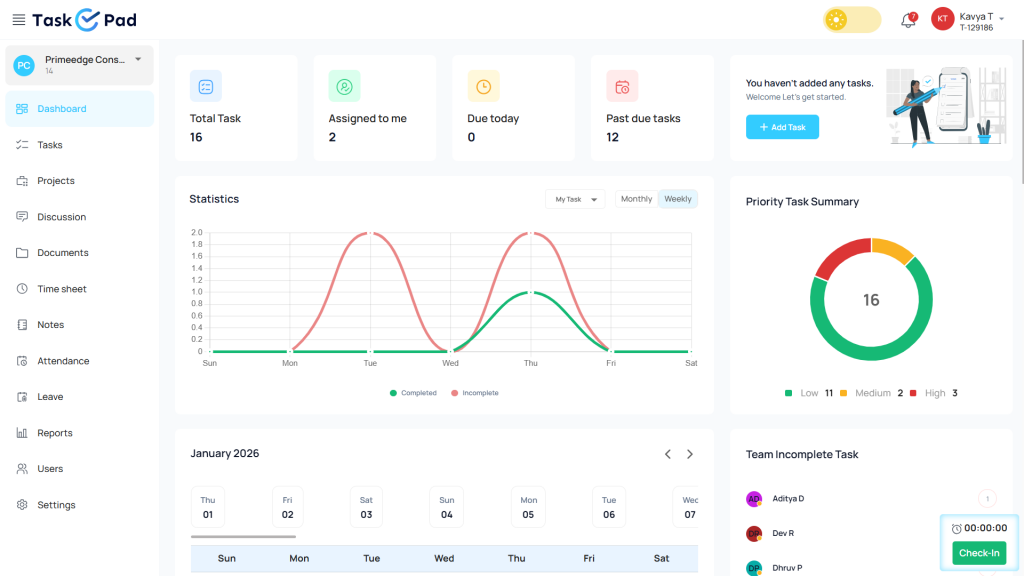
Implementing the CPM becomes much easier when supported by the right tools.
TaskOPad, recognized as one of the best task management software solutions, helps simplify CPM by allowing you to organize tasks, define dependencies, and track progress in a structured way. Instead of manually creating complex diagrams, you can manage everything in one place with better clarity.
With the help of project management software, teams can:
- Visualize task sequences and dependencies
- Track project timelines in real time
- Improve collaboration across teams
- Reduce manual errors in planning
Additionally, using a task planner app makes it easier to update tasks, monitor deadlines, and stay productive even while working on the go.
By combining CPM with a smart tool like TaskOPad, you can turn complex project planning into a simple and manageable process.
When Should You Use the Critical Path Method?
CPM is the right choice when:
- Your project has multiple interdependent tasks where sequence matters
- You have a fixed or contractual deadline that cannot be missed
- You need to identify schedule risk before work begins, not after delays appear
- You need to make informed resource allocation decisions based on task priority
- You need to communicate schedule logic to clients, stakeholders, or leadership
- Your project is large enough that informal tracking (spreadsheets, WhatsApp, email) creates coordination risk
Final Thoughts
The Critical Path Method (CPM) is one of the most effective techniques for planning and managing projects. By identifying the most critical tasks and focusing on the right priorities, you can ensure timely completion and better resource utilization.
While it may seem complex initially, CPM becomes easier with practice and the right tools. It helps you stay organized, reduce delays, and improve overall productivity.Ready to take control of your projects? Start managing your projects smarter with TaskOPad. Book a free demo and simplify your CPM workflow today.