☰
Project Management
Dec 29th, 2025
We’ve all seen this story: a big project kicks off with a lot of excitement, plenty of cash, and a great team. But fast forward a few months, and everything is falling apart. The schedule is behind, a major vendor quit, and the budget is disappearing. People call this “bad luck,” but usually, it’s just a failure to plan for the “what-ifs.” This happens when there is no risk mitigation considered.
In the current business landscape, where 70% of digital transformation projects fail to meet their goals (McKinsey, 2025), hope is not a strategy. Understanding risk mitigation in project management is the difference between a project that survives a crisis and one that collapses under it.
In simple terms, the risk mitigation is creating “Plan B” before you need it. It is the process of developing options and actions to enhance opportunities and reduce threats to project objectives.
Many people often confuse risk management with risk mitigation. Think of it this way:
Think of it like planning a road trip:
Risk Management is checking your GPS and understanding about the probable storm on your route. You’ve identified the problem and know it’s there.
Risk Mitigation is what you do about it. You make sure that the tires have plenty of tread, double-check your windshield wipers, and pack an emergency kit.
You aren’t just saying, “It might rain.” But, you are making sure that when it does rain, you don’t skid off the road. You’re taking the “teeth” out of the danger before it ever hits you.
As projects grow more complex, rely on remote teams, and face volatile markets, risk mitigation has become more critical than ever. Recent data clearly shows the steep price of ignoring these threats:
Before you can apply risk mitigation strategies, you need a systematic approach. You cannot mitigate what you haven’t measured.
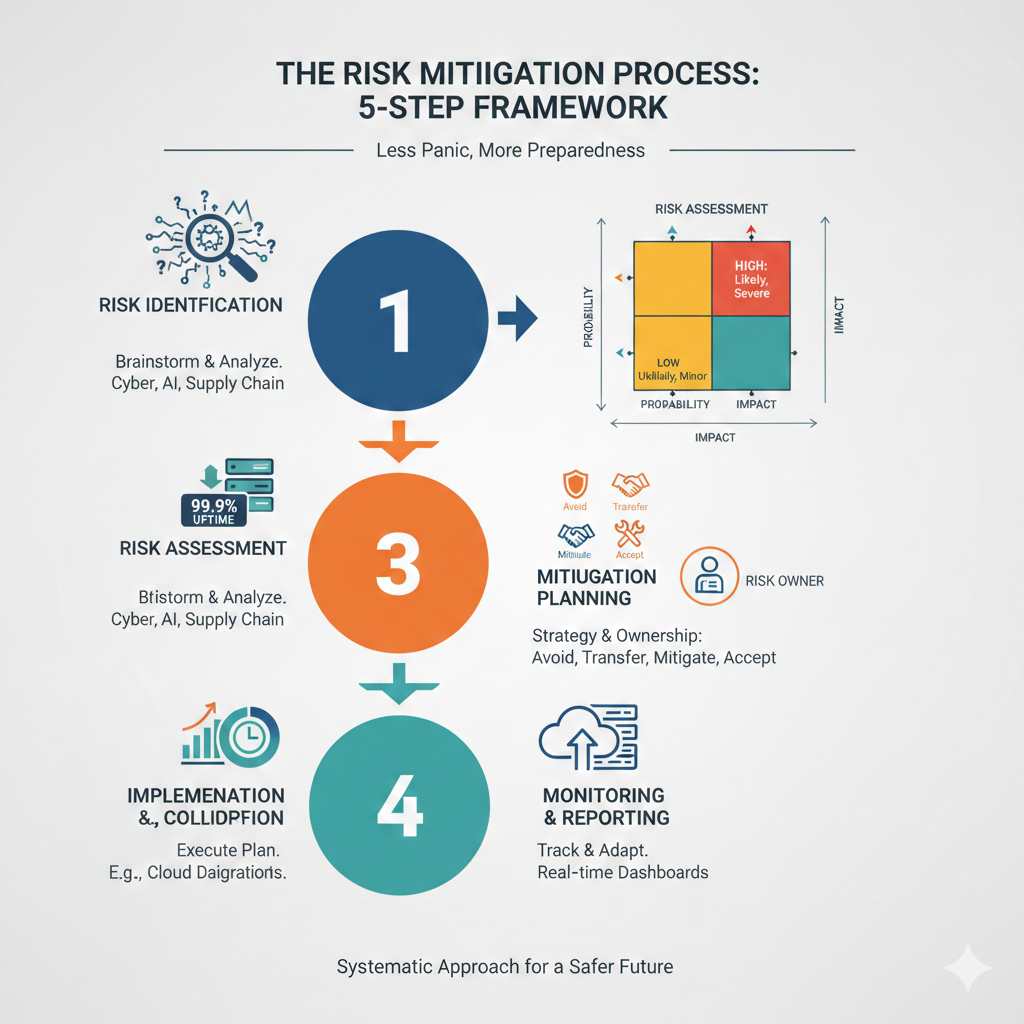
Gather your stakeholders. Brainstorm every possible thing that could go wrong. Look at historical data from past projects. Are there recurring bottlenecks? Common risks in 2026 include cyber threats, “AI hallucination” in automated workflows, and supply chain delays.
Not every problem deserves the same level of panic. Use a Risk Matrix to rank them based on two things:
Decide on your move: will you Avoid, Transfer, Mitigate, or Accept the risk? Most importantly, pick a “risk owner”. The risk owner will be the one person whose job is to keep an eye on that specific threat.
Execute the mitigation plan. If the risk was “server downtime,” the implementation might be migrating to a cloud-based project management software with 99.9% uptime.
Risks aren’t static; they evolve. A minor issue in January can become a disaster by March. Use real-time dashboards and quick audits to make sure you’re always a step ahead of the curve.
Choosing the right strategy depends on your organization’s risk appetite and the nature of the project.
| Strategy | Description | Example |
| Avoidance | Changing the project plan to eliminate the threat entirely. | A company cancels a product launch in a country facing sudden regulatory changes. |
| Transference | Shifting the impact and ownership of the risk to a third party. | Purchasing cyber insurance or hiring a specialized vendor to handle high-risk data migration. |
| Mitigation (Reduction) | Taking action to reduce the probability or impact of the risk. | Running extra quality assurance (QA) tests on software to prevent bugs at launch. |
| Acceptance | Acknowledging the risk but deciding not to take action unless it occurs. | Accepting that a minor delivery delay might happen due to winter weather. |
| Sharing | Distributing the risk among partners or stakeholders. | Entering a joint venture where two firms share the financial risk of a new R&D project. |
In 2025, managing risks on a spreadsheet is a risk in itself. Modern project management software acts as an early warning system. Here is how it changes the game:
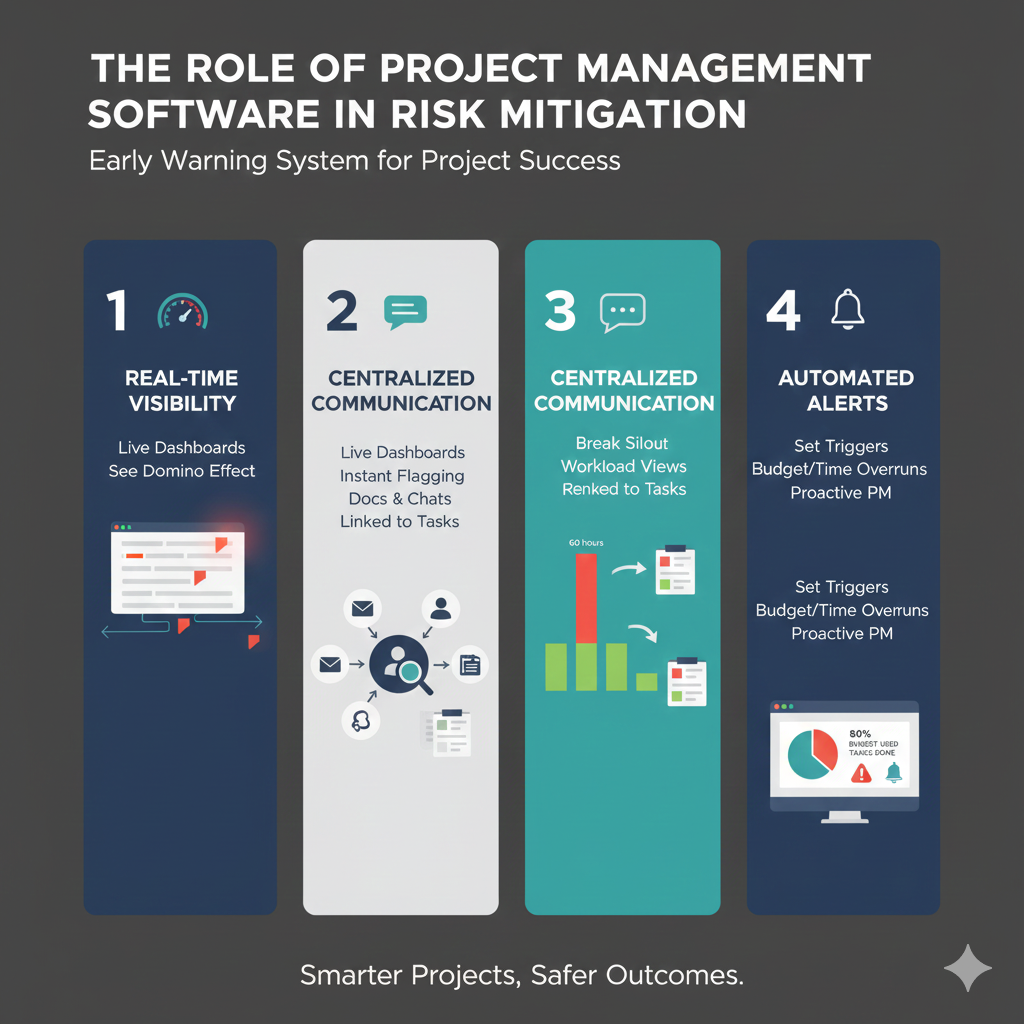
Manual reporting is often outdated by the time it reaches a decision-maker. Software provides live dashboards. If a task is overdue, the system flags it instantly. You can see the “domino effect” on the rest of the project before it happens.
29% of projects fail due to poor communication. When discussions happen in silos (email, Slack, and coffee chats), critical warnings get lost. A centralized tool keeps all risk-related documentation and conversations in one place, attached to the relevant tasks.
Overworking your team is a major performance risk. PM software allows you to see “workload views.” If one person has 60 hours of work assigned for a 40-hour week, you can reallocate tasks immediately to avoid burnout and errors.
You shouldn’t have to go looking for trouble. Advanced tools allow you to set “triggers.” For example, if a project hits 80% of its budget but only 50% of tasks are complete, the software sends an automatic alert to the project manager.
If you’re running a business or leading a project, keep these core principles in mind to stay ahead:
Risk is a given, but failure doesn’t have to be. With the correct risk mitigation strategies, the uncertainty can be turned into the things that can be managed very well. This helps us “firefighting” every day and start leading with confidence.
Great project management is a mixture of the correct mindset and the robust tools. While you focus on the big-picture strategy, let technology handle the tracking, alerts, and team collaboration.
TaskOPad is built to give leaders the visibility they need to stop risks before they become crises. With dashboards to track dependencies and real-time resource monitoring, it helps ensure your project stays on the winning side of the statistics.
Book your free demo today to see how you can execute risk mitigation and maximize your business productivity.
Search by posts
Search by posts
Recent posts
12-31-2025
Cloud Based Project Management Software
12-30-2025
Task Management Software
12-29-2025
Project Management For Managers
12-29-2025
Project Management
12-27-2025
Office Management Software




© Copyright 2026 Taskopad Solutions Private Limited. All rights reserved.