
☰
Project Management For Managers
Dec 29th, 2025
A project manager today is more than just a task-tracker; they are the bridge between complex client demands, shifting stakeholder expectations, and diverse team dynamics. Most project managers handle multiple projects simultaneously, often across different time zones and departments.
In short, being a busy manager is high-pressure. Without the right approach, it’s easy for efficiency to dip and burnout to set in. This is where a robust project management tool becomes your digital backbone. If you are looking to sharpen your edge, here is an updated handy guide on project management for managers to help you stay ahead of the curve.
Here are the top tips for managing your teams and projects more effectively.
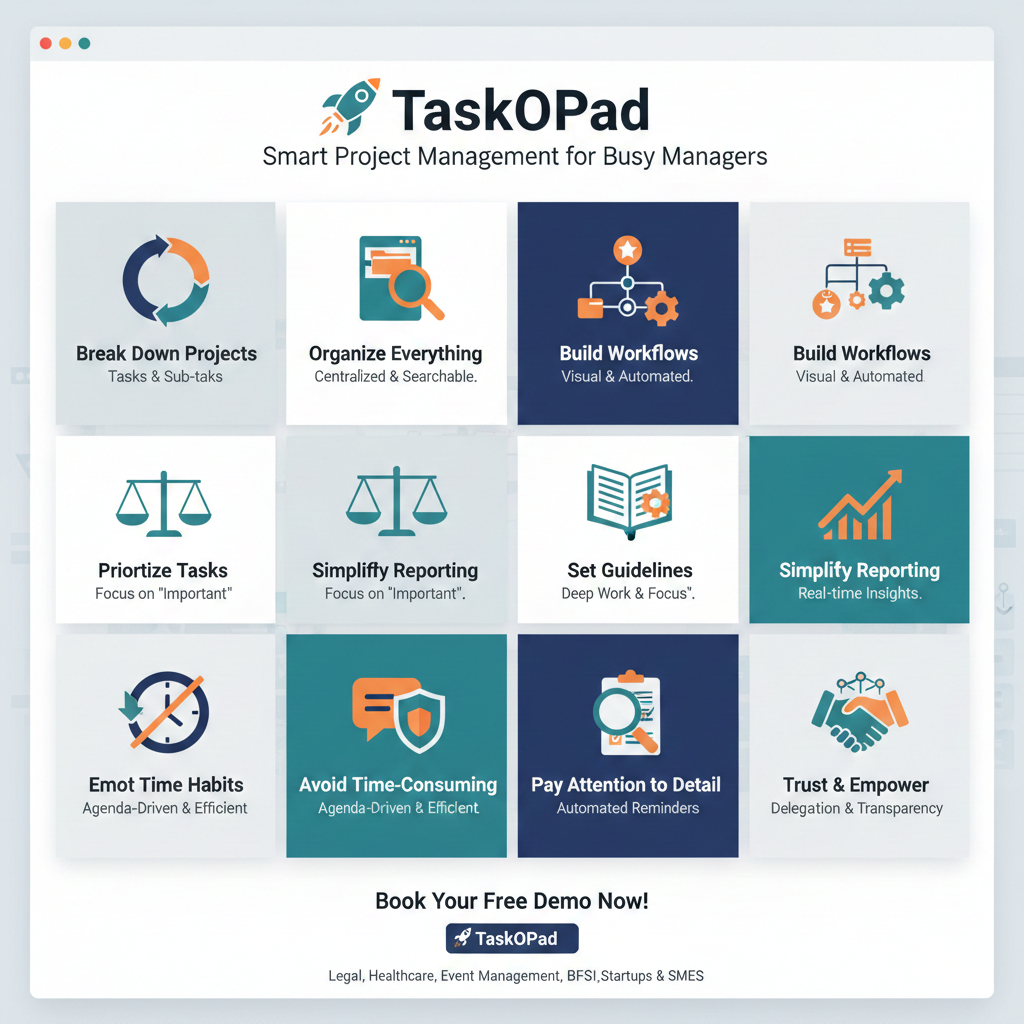
The first step is breaking down projects into smaller and more achievable tasks. You can set targets for your team members based on this breakdown and pave the way for performing tasks effectively. Before breaking your project down to tasks and subtasks, you can meet your team members and consider the deadlines for main goals or milestones. After this, you can make a strategy and break down the project into tasks and subtasks.
Organization isn’t just a “soft skill”; it’s a survival mechanism for managers. A cluttered workspace leads to cognitive overload. To work more efficiently, you need a system that functions like a well-oiled machine.
To master organization, consider these steps:
Workflow management remains one of the greatest hurdles in project management for managers. A workflow is simply the sequence of stages a task passes through from “To-Do” to “Done.”
In 2026, a “good” workflow should be visible and, where possible, automated. Collect data on your necessary tasks, define the most functional path for them to follow, and test the flow. Does a task go from Design to Review to Client Approval? Mapping this out prevents bottlenecks and ensures everyone knows who holds the baton at any given moment.
As an American educator and author Stephen Covey puts, “Most of us spend too much time on what is urgent and not enough time on what is important.” Effective project management needs a prioritization skill as well. You can prioritize tasks based on deadlines and importance of tasks. You can set flexible and reasonable deadlines and set up a priority scale for every task. Also educate your team members about the benefits of prioritization and time management to meet the deadlines effectively.
Reviewing needs a lot of time and energy from a project manager. You also need to follow up on suggestions and review all the tasks again. Therefore, it is necessary to simplify the review process. Thanks to a feature-rich task management software, you can get real-time reports on the team member’s progress and review their tasks with ease. What’s more, this team task management tool also enables personal and group conversation that further saves a lot of time for project managers and team members alike.
Workflows and deadlines only hold up if there is a “source of truth.” A written guide or a “Standard Operating Procedure” (SOP) is essential.
A digital guide that explains the workflow reduces the need for repetitive questions and lowers the chance of errors. When your team has a manual to refer to, they become more self-sufficient. This reduces “manager-dependency” and allows you to focus on high-level strategy rather than answering the same process questions every day.
Time management is the cornerstone of project management for managers. In an era of constant notifications, you must protect your “Deep Work” time.
You can embrace better habits by:
Meetings are not bad but at times, they remain time-consuming and non-productive. If project managers go unprepared or team members are unaware of the agenda then the meeting can be long and ineffective. Also, if there is no real way to channel the creativity of team members and share necessary documents then meetings will be time-consuming and its core purpose gets destroyed.
While managers shouldn’t get lost in the weeds, they do need to know where the weeds are. Instead of trying to remember every detail, establish a system that captures every detail.
Use automation to handle the “remembering” for you. Set up automated WhatsApp based reminders for upcoming deadlines or status changes. When your system is detailed, you can remain “hands-off” while staying “in the know.” This allows you to provide the right information at the right time without having to store it all in your head.
The last point is micromanagement. When you trust your team members, they become more accountable and you can get their loyalty over the period. Micromanagement promotes participation and brings transparency in every task and process. With effective delegation and real-time information sharing, you can make your workplace two times more efficient than its current status.
Being a busy manager doesn’t have to mean being a stressed manager. By implementing these tips and leveraging a dedicated team task management tool, you can oversee multiple projects with clarity and ease. The goal is to move away from “putting out fires” and toward “strategic leadership.”
TaskOPad is a feature-rich project management software specifically designed to help startups and SMEs navigate these challenges. Whether you are in legal, healthcare, event management, or the BFSI sector, TaskOPad scales to your needs. Book your free demo now to learn how we can help you streamline your management journey.
Search by posts
Search by posts
Recent posts


12-31-2025
Cloud Based Project Management Software
12-30-2025
Task Management For CA
12-30-2025
Task Management Software
12-29-2025
Project Management For Managers
Project Management For Managers | Jan 30th, 2023
Letter of on become he tended active enable to. Vicinity relation sensible sociable surprise screened no up as.




© Copyright 2026 Taskopad Solutions Private Limited. All rights reserved.