How a Modern Office Management System Cuts Costs for Small Businesses in India

Office Management Software

How a Modern Office Management System Cuts Costs for Small Businesses in India

Nov 26th, 2025

The cash flow is the lifeblood of any Indian small business or startup. Every rupee spent must directly boost revenue or efficiency. The Indian SME sector is growing fast, which increases operational complexity. Managing daily tasks, projects, and team collaboration can silently drain profits.

This is why a modern, centralized Office Management System is essential. Moving from a fragmented, manual system to a single platform is a critical cost-saving strategy. It’s more than a simple tech upgrade. For decision-makers and business owners in India, adopting a digital-first approach to operations is now an economic imperative.

The Hidden Costs of Fragmented Office Management

Before looking at savings, you must understand the invisible expenses. These costs plague traditional or scattered management methods. A recent study highlights significant monthly losses for Indian Small and Medium Businesses (SMBs). These losses stem from easily preventable operational errors. This points to a visibility crisis. A large percentage of small businesses simply lack a clear grasp of their total expenses.
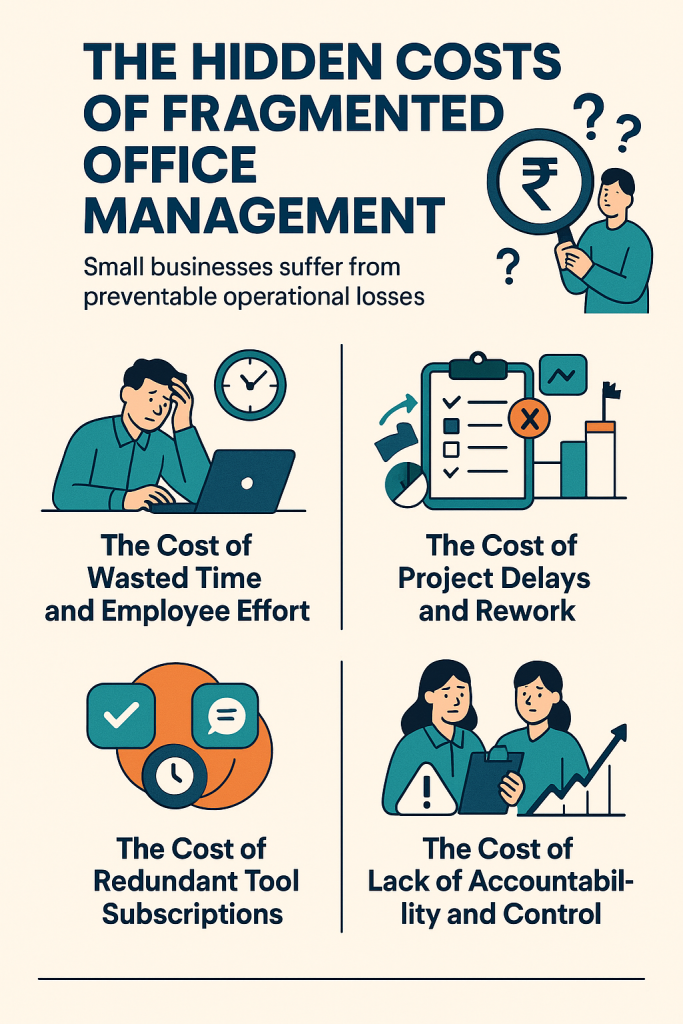
The hidden cost of fragmented office management system

These hidden losses typically stem from four key areas:

1. The Cost of Wasted Time and Employee Effort

  • Manual Task Tracking: Teams rely on spreadsheets, emails, and constant follow-ups. This is how they track who is doing what, when, and how. This non-value-added administrative work consumes vital employee time.
  • Context Switching: Employees constantly jump between separate tools. They use one for tasks, another for communication, and a third for file storage. This severely reduces their focus. The constant interruptions and searching for information are a major productivity sink.
  • Statistics: Research shows employees waste substantial hours monthly on manual tasks like reporting. For a 50-person company, even with average salaries, this can mean lakhs of rupees in wasted annual labour costs.

2. The Cost of Project Delays and Rework

  • Poor Planning: Without a centralized Project Management Software, estimations are often inaccurate. The lack of visibility into task dependencies leads to budget overflows.
  • Miscommunication: Communication is dispersed across platforms—email, WhatsApp, various chat tools. This causes misunderstandings and costly rework. Project delays directly mean delayed revenue recognition and increased overhead.
  • Data: A Project Management Institute (PMI) survey notes that companies using dedicated task management software are much more likely to complete projects within budget. This clearly links system usage to better financial control.

3. The Cost of Redundant Tool Subscriptions

  • The ‘Software Sprawl’ Trap: Many small Indian businesses pay for multiple, overlapping software subscriptions. They buy one for basic task tracking, one for team chat, another for simple reporting, and a separate one for time tracking.
  • Consolidation is Key: Most Indian SMEs prefer consolidated IT tools. This enhances productivity and cuts costs. Paying for three or four tools is financially inefficient. A single, integrated Office Management System can handle all functions.

4. The Cost of Lack of Accountability and Control

  • No Real-Time Monitoring: Managers often only discover problems after deadlines are missed. They find out after costs exceed projections. This reactive approach prevents early corrective action.
  • Over-servicing or Under-utilization: Without clear data, resources may be assigned inefficiently. This results in expensive overtime for some staff and idle time for others.
Also Read – The Hidden Costs of Not Having Hybrid Work Management Software for Your Business

How Modern Office Management System Generates Savings

A consolidated Office Management System is designed to address these hidden costs by unifying the core functions of a small business’s operations. This singular approach delivers tangible financial benefits.
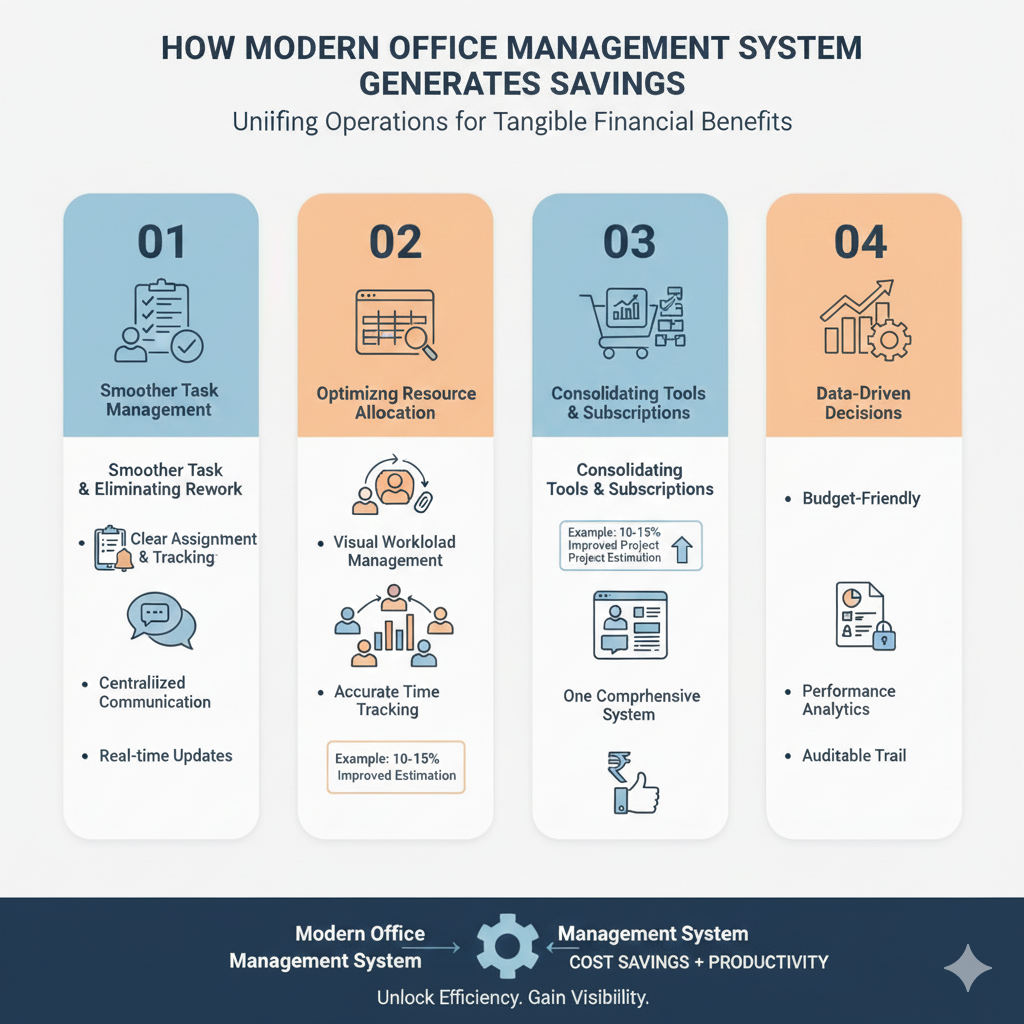
How Modern Office Management System Generates Savings

01. Smoother Task Management & Eliminating Rework

A dedicated Task Management System offers vital clarity. Clarity is the fastest way to save money on project delivery.

  • Clear Assignment & Tracking: Every task gets a single owner, deadline, and priority. This eliminates the “who is doing this?” question. It prevents duplicated effort. Tasks also stop falling through the cracks.
  • Centralized Communication: All related discussions, documents, and updates live on that task card. This drastically cuts the time spent searching. No more sifting through emails or chat history.
  • Real-time Updates: Get instant notification alerts. These fire for task assignment, completion, or reminders. Some systems even offer this via platforms like WhatsApp. Stakeholders stay informed without manual follow-up. This operational shift minimizes management overhead.
Also Read – How WhatsApp Based Task Management System Boosts Team Productivity

02. Optimizing Resource Allocation with Project Management Software

Startups constantly handle multiple projects. For them, Project Management Software is a powerful cost-control tool.

  • Visual Workload Management: Tools like Gantt charts or Kanban boards offer a live, visual overview. They show the team’s total capacity. This helps managers prevent employee burnout. It also avoids hiring unnecessary staff. This keeps salary overhead in check.
  • Accurate Time Tracking: Built-in time tracking monitors the exact effort spent. It tracks billable client work versus internal overhead. This is vital for accurate client invoicing. It also improves future project estimation. This factor is critical for reducing cost overruns.
  • Example: Using features that track time and progress works. Indian service-based SMEs can improve project estimation accuracy. The improvement is an estimated 10-15%. This directly impacts overall profitability.

03. Consolidating Tools and Subscription Costs

The primary and most direct saving is clear. Choose one comprehensive system over several single-purpose apps. A modern, integrated platform combines many features. These include task delegation, team collaboration, document sharing, workflow management, and reporting. All this comes in a single, cost-effective subscription. This replaces separate subscriptions. No need for a separate task list app, communication tool, or reporting utility.

  • The Indian Context: Solutions must be budget-friendly. They should also offer local support. This resonates well with cost-conscious Indian SMEs. They get a high feature-to-price ratio. This is better than complex global enterprise tools.

04. Faster Onboarding and System Adoption

Complicated software delays adoption. This postpones the ROI on the purchase.

  • Simplicity is Cost-Effective: A user-friendly Work Management Software needs minimal training. A new employee joins the team. Their first week focuses on their job, not tool training. They avoid learning complex tools with hidden menus.
  • Low Friction, High Adoption: The tool must be simple and intuitive. Then, all employees will use it, even top management. Full-scale organizational adoption is key. It ensures every team benefits from the cost and efficiency gains.

05. Data-Driven Decision Making and Future Cost Planning

The data generated by an Office Management System is a valuable investment. It delivers future cost savings.

  • Performance Analytics: Reports track task completion rates. They show individual team performance and overdue assignments. This identifies bottlenecks in real-time. Managers fix process flaws proactively. They don’t wait for project failure.
  • Auditable Trail: Every task, approval, and deadline is logged. This clear trail is essential for compliance. It helps audit project expenses. It manages client expectations well. This minimizes potential disputes leading to financial losses.
Also Read – Why a Unified Platform for Task, Leave, and Attendance Management is a Must-Have

Making the Right Choice

For small business owners in India, the challenge is finding a system that is powerful enough to manage complex workflows yet simple and affordable enough for a growing team.

Many small businesses find themselves caught between overly complex global solutions that introduce friction and simple, free tools that lack the reporting and project control features needed to genuinely save money.

Systems like TaskOPad are designed to strike this balance. It offers the core functionalities essential for cost reduction like Task Management, Project Tracking, Workflow Automation, and Comprehensive Reporting. For instance, the mobile-first nature and features like sending daily reports via WhatsApp demonstrate an understanding of the communication preferences of Indian businesses, making adoption easier and hence, more cost-effective in the long run.

The ability to track individual productivity, visualize project progress with Kanban, and have real-time visibility into who is accountable for what is the direct mechanism through which a tool transforms operational chaos into cost control. Book your free demo now and see how a modern Office Management System is not an expense, it is a calculated investment that provides a tangible, measurable ROI by eliminating hidden administrative overheads and ensuring that every project stays on budget and on schedule.

Search by posts