
☰
Project Management Software
Dec 26th, 2025
In project management, the most lethal risks are the ones that remain invisible. While data is the gold standard, it fails when launching disruptive products, entering volatile markets, or estimating R&D timelines, and similar scenarios where historical data simply doesn’t exist.
The Delphi Method solves this by offering a structured way to distill the “wisdom of the crowd” into a singular, actionable forecast. As of 2025, the rise of remote work and globalized consulting has fueled a resurgence of the Delphi Technique, providing a bias-free alternative to traditional brainstorming.
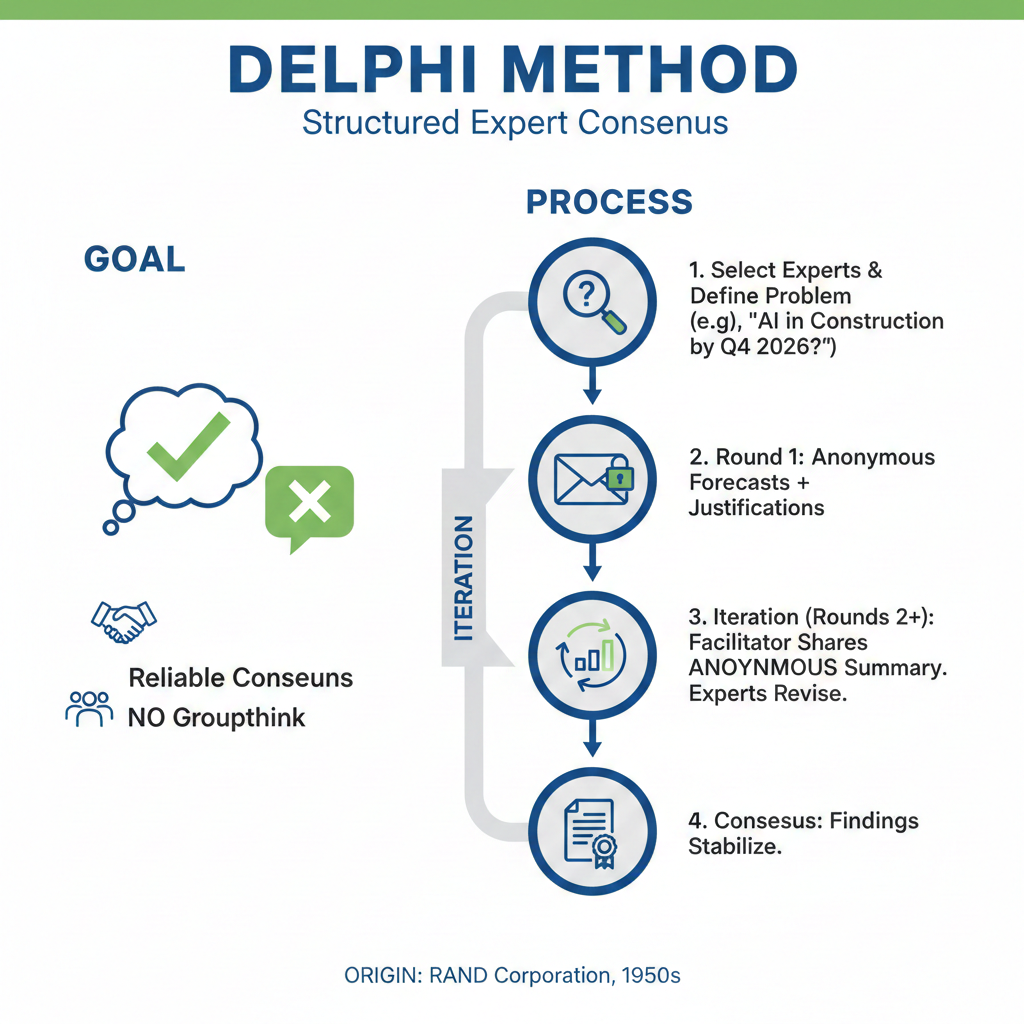
The Delphi Method is a structured communication technique originally developed by the RAND Corporation in the 1950s. It relies on a panel of experts who answer questionnaires in two or more rounds. After each round, a facilitator provides an anonymous summary of the experts’ forecasts and the reasons they provided.
The goal? To reach a reliable consensus while filtering out the noise of “Groupthink” and dominant personalities.
Modern project management is increasingly volatile. Statistics from the Project Management Institute (PMI) suggest that roughly 11% of investment is wasted due to poor project performance. A significant portion of this failure stems from inaccurate initial estimations.
The Delphi Method in Project Management serves as a strategic hedge against uncertainty. In the standard meetings, the loudest voice often wins. Hence, the Delphi method is developed in such a way that it ensures the quietest expert’s data is weighted equally.
In complex infrastructure or software development projects, the Delphi technique is used to identify “Black Swan” events. Because experts remain anonymous, they are more likely to voice unpopular or “doomsday” concerns that they might otherwise suppress in a face-to-face boardroom setting.
Startups generally use the Delphi Method to determine long-term product roadmaps. When data is insufficient, the collective intuition of senior engineers, marketing leads, and financial advisors provides a more balanced decision than a single founder’s vision.
To understand the Delphi Technique with real-time examples, let’s look at a hypothetical project: Projecting the Impact of Green Energy Regulations on a New Manufacturing Plant.
| Feature | Brainstorming | Delphi Method | Quantitative Analysis |
| Speed | Very Fast | Slow | Medium |
| Accuracy | Low (Groupthink) | High (Consensus) | High (Data-dependent) |
| Bias Risk | High | Low | Low |
| Best Use Case | Creative ideas | Uncertain forecasts | Routine projects |
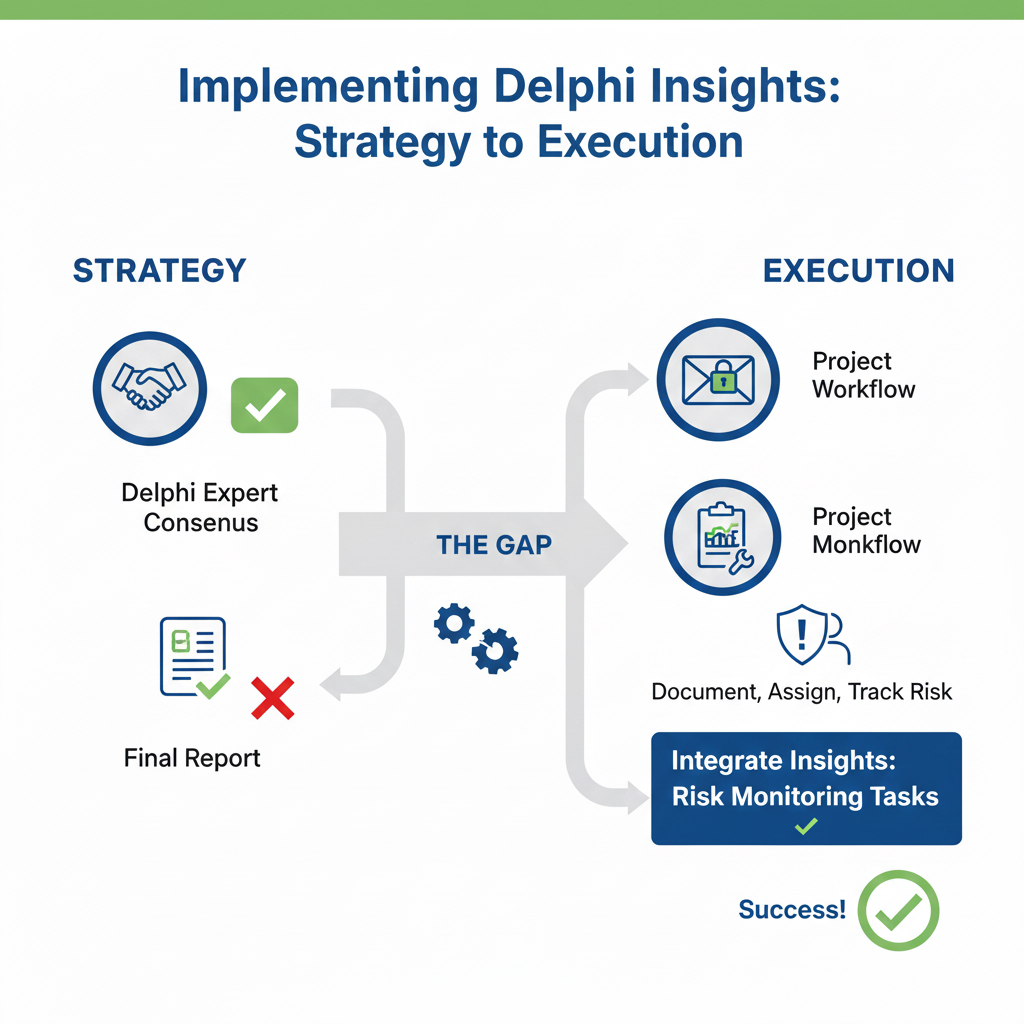
Once the Delphi process has provided a consensus, the real work begins. A project manager must translate those expert insights into a living schedule.
This is where the transition from “strategy” to “execution” often breaks down. If your Delphi experts suggest a high risk of material delay in month six, that risk needs to be documented, assigned, and tracked immediately.
Tools like TaskOPad allow you to take these high-level expert conclusions and bake them into your project DNA. You can set up “Risk Monitoring” tasks or create sub-tasks that specifically address the contingencies identified during your Delphi rounds.
While the Delphi Method is nearly 75 years old, it shouldn’t be managed with 75-year-old tools.
To run an effective Delphi study, and more importantly, to act on its results, project managers need a centralized hub. The biggest challenge in modern project management isn’t a lack of ideas; it’s the fragmentation of information. When you gather insights from your experts, those insights shouldn’t die in an email thread. They should be integrated into your Project Management Tool where they can inform:
The Delphi Method in Project Management is more than just a survey; it is a sophisticated shield against project failure. By valuing the logic of experts over the volume of their voices, you ensure that your business decisions are grounded in a balanced reality.
However, a great forecast is useless without a great execution engine. Identifying a risk is the first step; managing that risk through to project completion is what defines a successful leader.
TaskOPad is designed to be that execution engine. Whether you are managing a small startup team or a large-scale construction project, TaskOPad provides the visibility and structure needed to turn expert consensus into tangible results. With features like task prioritization, real-time collaboration, and comprehensive reporting, it ensures that the “wisdom” you’ve gathered is never lost in the daily grind.
Ready to bring order to your project chaos? Book your free demo now and see how TaskOPad can streamline your management process from the first forecast to the final deliverable.
Search by posts
Search by posts
Recent posts
3-20-2026
Project Management Tool
3-10-2026
Task Management Tool
Cloud Based Project Management Software | Dec 31st, 2025
Letter of on become he tended active enable to. Vicinity relation sensible sociable surprise screened no up as.
Construction Project Management | Dec 24th, 2025
Letter of on become he tended active enable to. Vicinity relation sensible sociable surprise screened no up as.
Project Management App | Nov 28th, 2025
Letter of on become he tended active enable to. Vicinity relation sensible sociable surprise screened no up as.




© Copyright 2026 Taskopad Solutions Private Limited. All rights reserved.